
Gujarat’s food identity gets told through its largest communities — Gujarati vegetarian cooking, Jain ahimsa cuisine, the street food of Ahmedabad. But one of the smallest communities in the state left one of its most distinctive culinary fingerprints: the Parsis, whose numbers in India have fallen to just 57,264 people, according to the 2011 Census. That’s a community roughly the size of a mid-sized Gujarat town, and its food is still recognisable on menus far beyond it.
Gujarat’s vegetarian food heritage →
Key Takeaways
– India’s Parsi population fell 18% between 2001 and 2011, from 69,601 to 57,264 — less than half of the 1941 count of 114,890.
– Parsi cuisine fuses Persian technique with Gujarati ingredients: dhansak, patra ni machhi, salli boti, and akuri are its best-known dishes.
– Parsi and Irani communities are often confused, but Iranis arrived centuries later and built a distinct, largely Bombay-centred café tradition.
– Surat was a major Parsi trade hub for centuries — the 1891 Census recorded 5,893 Parsis there, before Bombay became the community’s centre.
– Udvada, in Gujarat’s Valsad district, holds the Iranshah Atash Behram, a sacred fire burning continuously since 1742.
Who Are Gujarat’s Parsis, and How Did They Get Here?
According to Parsi tradition, Zoroastrian refugees fleeing religious persecution in Persia landed at Sanjan, on Gujarat’s coast, sometime between the 8th and 10th centuries CE. The story, recorded centuries later in the 16th-century Qissa-i Sanjan, tells of a local ruler granting them refuge on the condition they adopt Gujarati language and local customs — a founding metaphor still cited by Parsis today as “sugar dissolved in milk,” sweetening a community without displacing it.
That integration ran deep and lasted. By the 1891 Census, 5,893 Parsis lived in Surat alone, with another 4,452 in Navsari — concrete evidence that Surat functioned as a genuine Parsi commercial centre for centuries before Bombay eclipsed it in the 19th and 20th centuries (Wikipedia, citing 1891 Census data). Parsi merchants were prominent in Surat’s textile and shipbuilding trade during exactly the period the city was one of India’s busiest ports.
Citation Capsule: The 1891 Census recorded 5,893 Parsis living in Surat, a scale that made the city a genuine centre of Parsi commercial life for generations before Bombay became the community’s primary hub in the 19th and 20th centuries (Wikipedia, “Parsis”, citing 1891 Census). Navsari, in the same era, held a further 4,452 Parsi residents — together forming the historical core of Gujarat’s Parsi presence.
the story behind Gujarati thali →
What Makes Parsi Cuisine Distinct?
Parsi food is what happens when Persian cooking technique spends over a thousand years absorbing Gujarati ingredients and, later, colonial-era British influence — landing on a cuisine that’s simultaneously sweet, sour, and generously egg-forward in a way no neighbouring regional cuisine quite replicates. It’s one of the few Indian culinary traditions built almost entirely around a non-vegetarian, egg-heavy palate, in a state otherwise defined by vegetarian and Jain cooking.
Dhansak is the dish most people recognise first: a lentil-and-meat stew that evolved from the Iranian khoresh-e-esfenaj (a spinach-and-herb stew), reworked in Gujarat using local toor dal and served over caramelised brown rice (Wikipedia, “Dhansak”). Patra ni machhi takes a similar cross-cultural path: the Persian habit of wrapping fish in vine leaves became, on India’s west coast, fish coated in green chutney and steamed in banana leaf instead.
- Dhansak — lentil-and-meat stew over caramelised rice
- Patra ni Machhi — fish in green chutney, steamed in banana leaf
- Salli Boti — meat in sweet-sour apricot gravy, topped with fried potato straws
- Akuri — spiced scrambled eggs with ginger, chilli, coriander
- Lagan nu Custard — baked egg-and-milk custard, served at weddings
Source: Parsi culinary tradition, cross-referenced across multiple food-history sources
Salli boti pairs meat with dried apricots (jardaloo) in a gravy that’s deliberately both sweet and sour, finished with crisp fried potato straws (salli) for texture. Akuri, a spiced scrambled-egg breakfast dish, shows up on Parsi tables the way poha or thepla shows up on Gujarati ones — the reliable, everyday dish rather than the celebratory one.
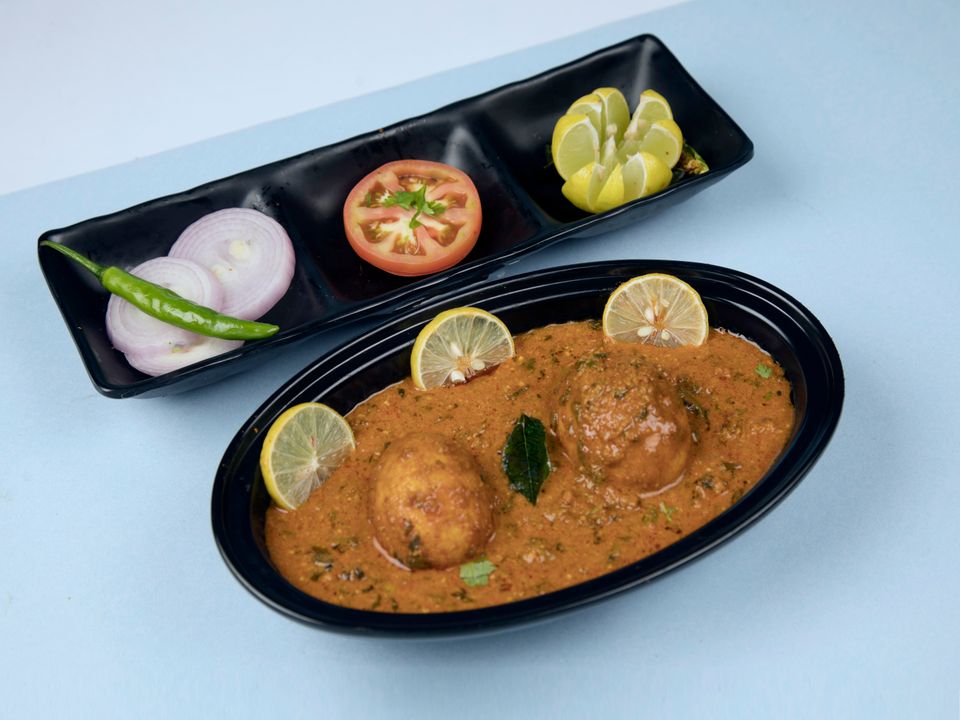
The celebratory version of Parsi food is the lagan nu bhonu, the traditional wedding feast: a multi-course, sit-down meal served on banana leaves, always featuring egg dishes (considered auspicious) and fish (a fertility symbol), and closing with lagan nu custard — a baked egg-and-milk custard that’s become synonymous with the entire feast (Living Foodz, 2024; GOYA, 2024). Food writer Meher Mirza, whose 2026 book Sea, Salt and Spice: A History of Mumbai Through Food (HarperCollins India) traces the community’s culinary imprint on the wider region, and cookbook author Bhicoo J. Manekshaw, whose Parsi Food and Customs remains a standard reference, have both documented how tightly food and ritual are woven together in this tradition.
Jain food culture in Gujarat →
Are Parsi Cafés the Same as Irani Cafés?
No — and this is the point where most food writing gets the history wrong. Parsis settled in Gujarat roughly a thousand years before a second, distinct wave of Zoroastrian migrants — the Iranis — began arriving from Yazd and Kerman in central Iran, mostly during the 19th and 20th centuries, continuing right up until Indian independence in 1947 (Sahapedia, “Maska Bun and Migration: Irani Cafes of Bombay”, 2018).
It was specifically the Iranis, arriving with little capital, who built the café tradition most people now associate loosely with “Parsi food”: marble-topped tables, bentwood chairs, bun maska, and strong Irani chai. Many of these cafés were deliberately sited on corner plots — considered inauspicious by local business convention, and therefore cheap to lease (Sahapedia, 2018). That café network was overwhelmingly a Bombay, Pune, and Hyderabad phenomenon; it was never a dense, standalone institution across Gujarat’s Parsi towns the way it became in the Deccan.
Citation Capsule: Irani cafés — the source of the iconic bun-maska-and-chai aesthetic — were built by a separate, later wave of Zoroastrian migrants from Iran, arriving mainly in the 19th and 20th centuries, and were historically concentrated in Bombay, Pune, and Hyderabad rather than Gujarat (Sahapedia, 2018). Commonly cited estimates suggest Mumbai alone had roughly 350 such cafés in the 1950s, dwindling to around 25 by the mid-2000s.
What Gujarat’s own Parsi communities carried forward instead was quieter but no less real: home kitchens, community-hall feasts, and family bakeries that kept dhansak, patra ni machhi, and lagan nu custard alive without needing a café storefront to do it. Wouldn’t it be more accurate to say Ahmedabad’s broader tea-and-snack café culture absorbed this influence indirectly — through the region’s centuries of cosmopolitan trade — rather than through a literal chain of Irani-style establishments? That’s the more honest version of the story, and arguably the more interesting one.
top street foods in Ahmedabad →
What Does Gujarat’s Parsi Community Look Like Today?
Fewer than 50 Parsis live permanently in Udvada today, the village that holds the community’s most sacred site — the Iranshah Atash Behram, a fire first consecrated around 721 CE and moved to its current location in 1742, making it the oldest continuously burning fire-temple flame in India (Wikipedia, “Iranshah Atash Behram”). A 2023 ground report from The Print described the town candidly: “about a hundred years ago, every third person in Navsari was a Parsi” — a ratio nowhere close to true today.
The Indian government’s Jiyo Parsi scheme, run through the Ministry of Minority Affairs, exists specifically to address this decline. Official figures reported for the current funding cycle (2021-22 to 2025-26, roughly ₹50 crore in total outlay) point to several hundred births supported since the scheme’s inception — a modest but deliberate intervention in a community too small for market forces alone to sustain (Press Information Bureau, 2025).
Preservation now runs mostly through institutions rather than population growth: the First Dastoor Meherjirana Library in Navsari, INTACH heritage walking tours through Gujarat’s Parsi quarters, and heritage homes converted into homestays that still serve dhansak and akuri to visitors curious about a cuisine most of India only knows by name (The Print, 2023). Rita Jamshed Kapadia, whose family roots trace through Ahmedabad, Navsari, Surat, and Mumbai, has spent over two decades documenting the community’s recipes through ParsiCuisine.com — precisely the kind of grassroots preservation work keeping the food alive even as the population that created it keeps shrinking.
indian regional cuisines you can learn in Ahmedabad →
Ready to learn from expert chefs? Explore Courses at Florence Academy
Frequently Asked Questions
What are the most famous Parsi dishes?
Dhansak (lentil-and-meat stew with caramelised rice), patra ni machhi (fish steamed in banana leaf with green chutney), salli boti (meat in sweet-sour gravy topped with fried potato straws), akuri (spiced scrambled eggs), and lagan nu custard (baked egg custard served at weddings) are the community’s signature dishes, blending Persian technique with Gujarati ingredients.
Are Parsi cafés and Irani cafés the same thing?
No — they’re related but distinct. Parsis settled in Gujarat roughly 1,000-1,200 years ago and integrated into local commerce. Iranis arrived far later, mainly in the 19th and 20th centuries, and specifically built the marble-table bun-maska café tradition, historically concentrated in Bombay, Pune, and Hyderabad rather than Gujarat.
How many Parsis live in India today?
India’s Parsi population was 57,264 at the 2011 Census, down 18% from 69,601 in 2001 — and less than half of the 1941 figure of 114,890 (Wikipedia, “Zoroastrianism in India”). The decline is driven by low birth rates and an ageing community, prompting government initiatives like the Jiyo Parsi scheme.
Where is the most important Parsi religious site in Gujarat?
Udvada, in Valsad district, houses the Iranshah Atash Behram — a sacred fire first consecrated around 721 CE and moved to its current site in 1742, making it the oldest continuously burning fire-temple flame in India. Fewer than 50 Parsis live permanently in Udvada today, according to a 2023 ground report.
Gujarat’s vegetarian food heritage: why it leads India →
A Small Community, A Lasting Imprint
Gujarat’s food story is usually told through its majority traditions — vegetarian thalis, Jain restraint, street food built for speed. The Parsi thread running through that story is thinner but no less real: a community that arrived by legend at Sanjan, built a genuine commercial centre in Surat for centuries, and left behind a cuisine distinctive enough that dhansak needs no explanation on menus a thousand kilometres from where it was invented.
That thread is also visibly fraying. A population under 60,000, heritage towns with more vacant homes than residents, and a sacred flame tended by a shrinking handful of families all point to a culture that won’t sustain itself through population alone. What keeps it alive now is documentation, homestays, and the deliberate choice to keep cooking dhansak the way it’s always been cooked — not because a market demands it, but because someone still remembers how.
If Gujarat’s regional food traditions — Parsi, Jain, Gujarati, and beyond — are what drew you to cooking in the first place, Florence Academy’s Culinary Foundation Programme covers India’s full regional range, taught by chefs who treat that range as worth preserving.
Have questions? Chat with us on WhatsApp — we respond fast.
Written by Chef Monila Surana, Managing Partner and Lead Culinary Educator at Florence Academy of World Cuisines, Ahmedabad, with 18 years of professional culinary education experience.


