
A Gujarati wedding is one of the most elaborate food events in India. Over 3-5 days of ceremonies, a traditional Gujarati family serves dozens of dishes, each tied to a specific ritual, time of day, or community tradition. India’s wedding industry is valued at $50 billion (IBEF, 2024), and Gujarat ranks in the top three states by wedding spend per capita. Food is the centre of every celebration here. This guide covers what’s served at each ceremony, why the dishes matter, and how Gujarati wedding food differs by region.
Key Takeaways
– A traditional Gujarati wedding spans 3-5 days, each ceremony with its own food format and dishes.
– The Jaan Bhojan (wedding day lunch) is the centrepiece: an unlimited vegetarian thali with dal, kadhi, shaak, farsan, and sweets.
– Gujarat’s four regions, Saurashtra, Kutch, Central Gujarat, and South Gujarat, each bring distinct flavours to the wedding table.
– India’s wedding industry is valued at $50 billion (IBEF, 2024); food is the single largest spend category.
– Modern Gujarati weddings now blend traditional thali service with live counters and dessert stations.
How Many Days Does a Traditional Gujarati Wedding Last and What’s Served Each Day?
A traditional Gujarati wedding spans 3-5 days, with food formats shifting from casual grazing to structured sit-down service. India’s wedding industry generates roughly $50 billion annually (IBEF, 2024), and Gujarat’s multi-day celebrations contribute a significant share. Each ceremony has its own food register: finger food, fasting-friendly snacks, a full ceremonial thali, or a modern reception spread.
Day 1: Pithi and Haldi Ceremony
The pithi and haldi ceremonies are light, festive occasions. Food stays in finger-food format: fafda-jalebi, farsan platters, fresh fruits, dry fruits, and chevdo. Nobody sits down for a structured meal. Tea and chaas (spiced buttermilk) flow continuously throughout the morning and afternoon.
The cooking is intentionally simple. Families are busy with rituals, guests come and go at different hours, and the atmosphere is relaxed. The food reflects that mood: easy to eat standing, easy to serve in batches, and impossible to get wrong.
Day 2: Garba Night
Garba night is a grazing occasion, not a sit-down meal. Bhajia, chakli, dal vada, and batata vada all come from frying stations set up around the venue. Guests eat between dances, not before or after. Some families and guests observe upvaas (fasting) and stick to specific fasting-approved dishes.
The energy on garba night demands food that’s quick, hot, and portable. A formal meal would interrupt the dancing. This is why the food station format has stayed consistent across generations, even as wedding budgets have grown dramatically.
Day 3: The Wedding Day Jaan Bhojan
This is the main event. The Jaan Bhojan (literally “groom’s party meal”) is a full ceremonial lunch served to hundreds of guests simultaneously. This is where the traditional Gujarati wedding thali appears in its complete form. We cover this in detail in the next section, because it deserves full attention.
Day 4: The Reception
Modern Gujarati wedding receptions look different from the traditional Jaan Bhojan. Live counters for pasta, chaat, Chinese, and mocktails now sit alongside, or sometimes replace, the traditional service. Dessert stations have become a visual focal point. The shift reflects rising aspirations and the influence of destination weddings on local formats.
Citation capsule: India’s wedding industry is valued at $50 billion annually, with Gujarat ranking among the top three states by per-capita wedding spend (IBEF, 2024). Multi-day Gujarati weddings allocate the largest share of that spend to food, with the Jaan Bhojan alone typically serving hundreds of guests an unlimited ceremonial thali.
What Is Served at a Traditional Gujarati Wedding Thali?
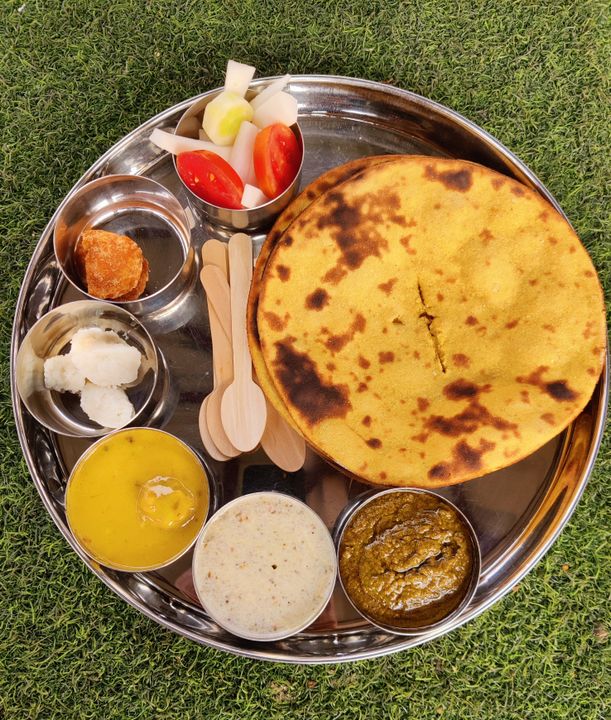
The Jaan Bhojan thali is the culinary centrepiece of a Gujarati wedding. According to Gujarat Tourism, the Gujarati thali is recognised as one of the most nutritionally complete vegetarian meal formats in Indian cuisine. A traditional wedding thali includes no fewer than 10-12 distinct components, served simultaneously and refilled until the guest signals they are done.
The Core Dishes
Dal and kadhi anchor the thali. Gujarati wedding dal is thin and slightly sweet, not the thick lentil preparations common in North India. Kadhi, a yoghurt and gram flour curry, is mildly spiced and poured generously alongside the dal. Both dishes define the flavour register of the entire meal.
Shaak means vegetable preparation, and a wedding thali includes at least two, often three or four. One is typically dry (sukhi bhaji), one is gravy-based. The vegetables reflect the season and the region. During winter weddings in Central Gujarat, undhiyu, a slow-cooked mixed vegetable preparation, frequently appears.
Puri and thepla both appear at traditional weddings. Puri carries the celebratory register: fried, puffed, golden. Thepla brings the everyday familiarity that comfort food provides at a long meal. Plain steamed rice accompanies the dal for those who prefer it.
Papad, aachar, and chutneys complete the essential elements. Papad is large and crisp. Aachar is locally made, often raw mango during the season. At minimum, two chutneys appear: green coriander and tamarind-jaggery. These aren’t garnishes. They’re active components of the flavour balance.
The Farsan Plate
Farsan at a wedding thali is not a starter. It arrives alongside the main thali: dhokla, khandvi, gathiya, mini samosa. At North Indian weddings, starters precede the meal. At a Gujarati wedding, farsan and the main meal coexist on the table simultaneously. This is a structural distinction that surprises many first-time guests.
The Sweets
Shrikhand is the essential wedding sweet: strained yoghurt, sugar, cardamom, and saffron. Gulab jamun or jalebi also appear, and at least one traditional mithai, mohanthal, gharek, or sukhdi, depending on the region. A wedding with fewer than three sweets would raise eyebrows in most Gujarati communities.
Chaas, spiced buttermilk, is served throughout the meal. It’s considered essential for digestion at a large meal, not an optional beverage.
Chef Monila Surana recalls her first large-scale Gujarati wedding catering assignment: 800 guests, five sweets, four vegetable dishes, two dals, and the realisation that the Gujarati wedding thali has no fixed portion. Food is refilled until the guest signals they are done. Managing unlimited thali service for 800 people simultaneously is what she points to when students ask about the real demands of large-scale catering. The logistics of that day, she says, taught her more about kitchen management than any single classroom session.
Citation capsule: The traditional Gujarati wedding thali includes 10-12 components served simultaneously, with unlimited refills as a cultural standard. Gujarat Tourism recognises the Gujarati thali as one of the most complete vegetarian meal formats in Indian cuisine (Gujarat Tourism). The thali’s sweet-salty-sour balance reflects Ayurvedic principles of nutritional completeness at celebration meals.
How Does Wedding Food Differ Across Gujarat’s Regions?
Gujarat’s four main regions produce distinct wedding food traditions, shaped by local ingredients, community customs, and historical trade influences. The 2011 Census of India recorded Gujarat’s population at over 60 million (Census of India, 2011), spread across communities with deeply distinct food cultures. A Saurashtra wedding thali and a Surat wedding thali share the same structure but taste noticeably different.
| Region | Distinctive Wedding Dishes | Flavour Profile |
|---|---|---|
| Ahmedabad / Central Gujarat | Puri-shaak, dal-dhokli, shrikhand, mohanthal | Sweet-balanced, festive |
| Saurashtra / Kathiawar | Kadi khichdi, bajra rotla, gaar (sweet), gathiya | Robust, earthy, spicy |
| North Gujarat | Ringan na bharta, methi thepla, khakhra, adadiya | Earthy, slightly bitter, wholesome |
| South Gujarat / Surat | Undhiyu, ponk (tender sorghum), surti locho, ghari | Sweet, festive, season-specific |
| Jain Adaptations (statewide) | No-root-veg versions of all above using suran, raw banana | Faithful flavour with Jain compliance |
Source: Florence Academy culinary curriculum / Gujarat Tourism
Saurashtra: Ghee-Forward and Lentil-Rich
Saurashtra, covering Rajkot, Junagadh, and Bhavnagar, produces the heaviest and richest wedding food in Gujarat. More ghee, more gram flour preparations, lentil-forward cooking. The wedding staple here is vaghareli khichdi, a tempered rice-and-lentil preparation, rather than plain steamed rice. Dry farsan, gathiya and chakli in particular, appears in greater volume than elsewhere in the state.
Saurashtra’s agricultural heritage means grains and legumes dominate the plate. The richness of the food reflects both abundance and the region’s tradition of feeding guests generously, even extravagantly.
Beyond the wedding table, Kathiyawadi cuisine explains why Saurashtra’s everyday cooking runs on groundnut oil and bajra.
Kutch: Dry Spices and Deep Tamarind
Kutchi wedding food is defined by dry spice profiles, dried mango, and generous tamarind. The flavours run tangier and more complex than Central Gujarat’s cleaner, sweeter style. Kutchi weddings, especially in smaller communities, often include Kutchi Dabeli as a casual snack during non-ceremonial events. The landscape, arid and sun-baked, shaped a cuisine that preserves well and tastes bold.
Central Gujarat: Refined and Jain-Influenced
Ahmedabad, Anand, and Vadodara produce what many consider the most refined version of the Gujarati wedding thali. The strong Jain and Vaishnav Hindu presence across Central Gujarat means weddings typically omit garlic and onion, even in non-Jain families. The logic is social: a wedding is a shared sacred occasion, and food that everyone can eat without restriction is the default. The Ahmedabad wedding thali is the most widely documented and recognised version of the tradition.
South Gujarat: The Sweetest Table
Surat, Valsad, and Navsari produce the sweetest versions of Gujarati wedding food. The chutneys are sweeter, the dal is sweeter, and the mithai portions are generous. Surti Locho, a steamed gram flour snack from Surat, appears at wedding events as a signature local touch. The chaas here runs slightly more tangy, a contrast to the sweetness in everything else on the table.
The regional variation across Gujarat’s wedding tables isn’t random. It tracks the state’s agricultural and trade history precisely. Saurashtra’s legume-forward cooking reflects dryland farming. South Gujarat’s sweetness reflects sugarcane cultivation in the Tapi River basin. Kutch’s tamarind use reflects caravan trade routes. The wedding table, in each region, is a direct record of what the land produced and what the community traded. This is what makes Gujarati wedding food worth studying as food culture, not just as a menu.
Citation capsule: Gujarat’s four culinary regions, Saurashtra, Kutch, Central Gujarat, and South Gujarat, each produce distinct wedding food traditions shaped by local agriculture and community customs. The 2011 Census of India recorded Gujarat’s population at over 60 million (Census of India, 2011), spread across communities with deeply distinct food identities that remain visible in wedding menus today.
How Has Modern Gujarati Wedding Food Changed?
Traditional Gujarati wedding food is adapting to urban lifestyles and rising aspirations without disappearing. India’s wedding catering segment has grown at roughly 15-20% annually over the past decade (IBEF, 2024), and the shift is visible in what’s served. Live counters for pasta, dim sum, and chaat now sit alongside traditional thali service at most urban weddings. Guests want both.
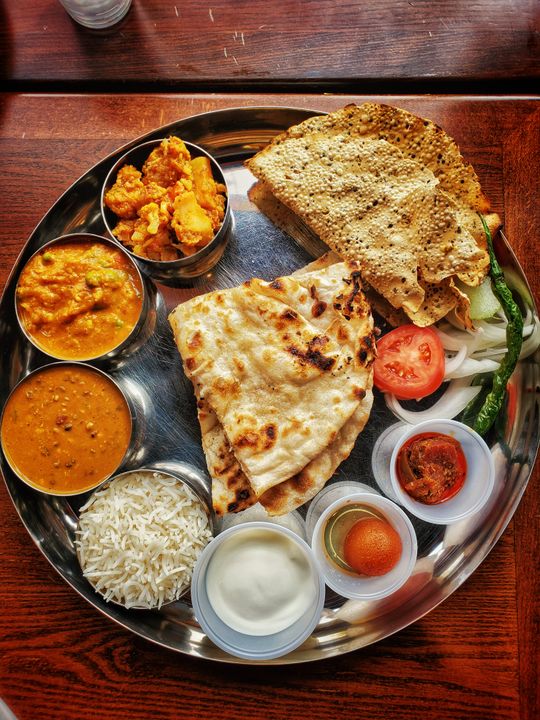
The traditional sit-down Jaan Bhojan is increasingly replaced by a Sunday brunch-style format at receptions. Guests graze from stations rather than sitting in rows for simultaneous thali service. This format reduces logistical complexity but also changes the social experience: the communal sit-down meal, where 500 people eat together, is a distinct cultural moment that the grazing format doesn’t replicate.
Dessert stations have replaced traditional mithai service at many urban receptions. Pastry chefs now compete with traditional mithai shops for wedding contracts. Custom wedding cakes coexist alongside mohanthal and laddoo. Neither has displaced the other, but the visual language of the dessert table has shifted decisively toward display and spectacle.
Mocktail bars have replaced the traditional chaas station at many receptions. The functional role of chaas, aiding digestion at large meals, doesn’t disappear; it gets repackaged as a flavoured drink alongside other mocktails rather than served from a dedicated bucket in the service line.
Florence Academy’s catering diploma students consistently identify Gujarati wedding catering as the highest-demand practical skill in their first year of professional work. The academy added large-scale wedding thali service to its diploma curriculum in 2019, after 30+ graduates entered wedding catering directly from the programme. That curriculum now covers refill logistics, bain-marie management, simultaneous service coordination, and regional thali variation, because the industry demanded it.
Citation capsule: India’s wedding catering segment has grown at roughly 15-20% annually over the past decade (IBEF, 2024), with Gujarat’s urban wedding market driving demand for hybrid menus that combine traditional Gujarati thali service with live counters, dessert stations, and mocktail bars alongside, not instead of, the ceremonial food.
Ready to learn from expert chefs? Explore Courses at Florence Academy
FAQ: Gujarati Wedding Food
How many people typically attend a Gujarati wedding?
Large-scale Gujarati weddings typically host 500-2,000 guests. Community weddings in Saurashtra and Kutch often exceed 2,000. Urban Ahmedabad weddings have become smaller (200-500 guests) due to venue constraints and rising costs. The expectation of abundance in food service remains regardless of size. Unlimited thali service is the cultural standard across every guest count.
Is Gujarati wedding food always vegetarian?
Yes. Traditional Gujarati wedding food is entirely vegetarian, driven by the strong Jain and Vaishnav Hindu traditions that shape Gujarat’s food culture. Even families who eat non-vegetarian food at home typically serve strictly vegetarian at weddings. Ceremonies are considered sacred occasions, and vegetarian food is regarded as sattvic, meaning pure, in both Jain and Vaishnav Hindu traditions.
What is the significance of shrikhand at a Gujarati wedding?
Shrikhand (strained sweetened yoghurt with saffron and cardamom) is an auspicious dish in Gujarati tradition, associated with celebration and abundance. It appears at the wedding thali as the primary sweet: not just for flavour but because the white and gold saffron colour combination represents purity and prosperity in Vaishnav and Jain traditions. A wedding thali without shrikhand would be incomplete.
How do you cater a Gujarati wedding thali for 500+ guests?
Large-scale Gujarati wedding catering requires service coordination as much as cooking skill. Dishes are held in jacketed bain-marie vessels on the service line. Unlimited service means refill logistics must be planned in advance, typically one server per 10-12 guests, with a dedicated sweet and farsan counter running separately. The Florence Academy Diploma programme covers this workflow directly, drawing on real wedding catering experience.
What Makes Gujarati Wedding Food Worth Understanding?
Gujarati wedding food is not decoration. Every dish on the thali carries a practical purpose, a regional identity, or a ritual meaning. The Jaan Bhojan unlimited thali, the fasting-friendly garba night snacks, the sweet-forward South Gujarat mithai plate, and the ghee-rich Saurashtra vaghareli khichdi all reflect how deeply food is woven into the fabric of the occasion.
Understanding the structure of Gujarati wedding food helps you understand Gujarati food culture more broadly. The thali’s balance of sweet, salty, sour, and spicy isn’t accidental. It mirrors the Ayurvedic principle that a complete meal supports digestion, satisfaction, and celebration simultaneously.
If you’re interested in learning to cook and serve food at this level, whether for wedding catering, hospitality, or your own professional development, the Culinary Foundation Course at Florence Academy gives you the technical foundation. For large-scale catering and service, the Diploma in Food and Beverages goes further.
Have questions? Chat with us on WhatsApp – we respond fast.


