
Raksha Bandhan falls on August 9 this year, and most conversations about it centre on the thread. The rakhi. The ritual. But spend a morning in any Gujarati kitchen the day before the festival and you’ll understand quickly: the food is just as central as the ceremony. The plate that gets assembled on Raksha Bandhan morning is not an afterthought. It is carefully composed, regionally distinct, and carrying layers of symbolic meaning that most families enact without ever articulating why. This guide unpacks those traditions, region by region, with particular depth on Gujarati food customs.
Key Takeaways
– Raksha Bandhan generates an estimated ₹6,000-8,000 crore in sweets and gifts annually (industry estimate, 2024)
– The Raksha Bandhan thali has 5 ritual elements; the sweet is the only one consumed
– Mohanthal is the most traditional Gujarati festival sweet for Raksha Bandhan
– Every regional tradition in India uses dairy as the primary ingredient in festive sweets
– Homemade sweets carry cultural weight that store-bought items cannot fully replicate
What Is the Significance of Food in Raksha Bandhan?
Raksha Bandhan generates an estimated ₹6,000-8,000 crore in economic activity around sweets and gifts each year (India Brand Equity Foundation, 2024), making it one of India’s top five gifting festivals. That number matters because it reflects something older than commerce: in this festival, the sweet is not a side element. It is the medium through which the blessing travels.
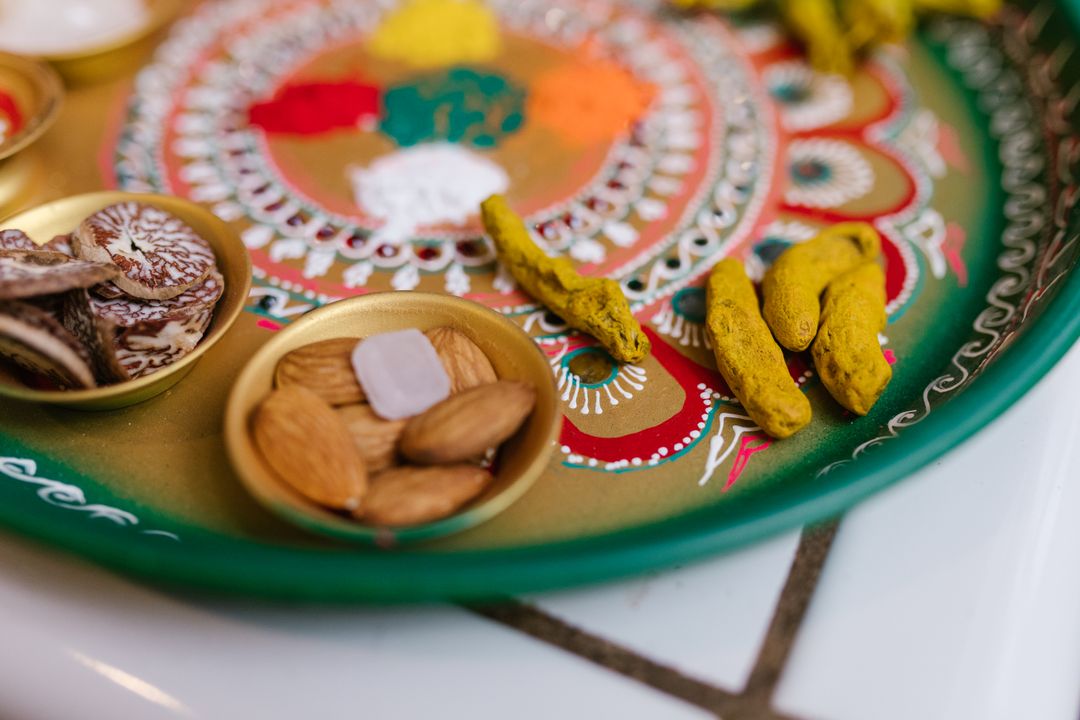
The ritual thali assembled for Raksha Bandhan holds five elements: kumkum (vermillion), akshata (rice grains), a diya (lamp), the rakhi itself, and meetha (the sweet). Of these five, only the sweet is consumed. Everything else is placed, applied, or tied. The sweet is the act of nourishment, and nourishment is the act of care. That is the core logic of the food tradition here.
The moment of feeding matters, too. In many families, the sibling exchange involves one feeding the other the first bite. This isn’t incidental. Food as a gesture of blessing and protection appears throughout Hindu festival traditions, and Raksha Bandhan is among the most explicit expressions of it. The thread binds. The sweet blesses.
Raksha Bandhan is estimated to generate ₹6,000-8,000 crore in annual economic activity through sweets and gift exchange, placing it among India’s top five gifting festivals by commercial scale (India Brand Equity Foundation, 2024). The sweet in the ritual thali is the only consumable offering among five ceremonial elements.
In Gujarat specifically, the Raksha Bandhan thali is prepared with particular care for auspiciousness. The specific items vary by family. The presence of freshly made mithai, however, is consistent. A purchased sweet signals affection. A made sweet signals something more.
What Foods Are Traditionally Made for Raksha Bandhan in Gujarat?
Gujarat’s Raksha Bandhan food centres on ghee-based sweets made at home, reflecting a broader Gujarati culinary principle: celebration is marked by richness, not by spice. (Gujarat Tourism documents this dairy-forward festival food identity as central to the state’s culinary heritage.) Here are the dishes most consistently found on the Gujarati Raksha Bandhan table.
Mohanthal
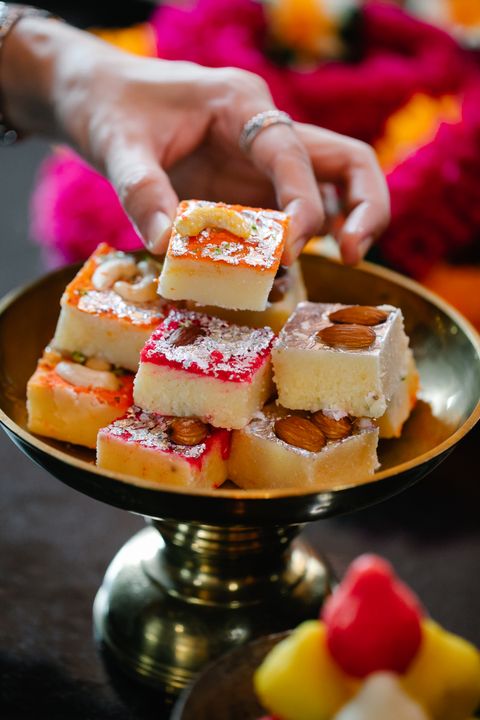
Mohanthal is gram flour (besan) fudge, slow-roasted in generous ghee until deep golden, then set with a sugar syrup flavoured with saffron and cardamom. It is the most distinctively Gujarati festival sweet. Preparation takes two to three hours and the roasting stage is where skill is tested. Under-roast it and the flavour is flat. Over-roast it and the bitterness carries through. The texture should be dense and smooth, cutting cleanly but yielding on the palate.
Boondi Laddoo
Fried chickpea flour droplets in sugar syrup, shaped into balls while still warm. Boondi laddoo appears at celebration across both Gujarati and Rajasthani traditions. It requires speed and experience: the rolling must happen before the syrup sets. Many families now buy boondi laddoo from trusted mithai shops rather than make it at home, though homemade versions are considered superior in freshness.
Shrikhand
Strained sweet yoghurt with saffron and cardamom, served chilled. Shrikhand is not a gifting item. It sits on the lunch or dinner plate as a ritual constant at almost every Gujarati festive meal. The straining process takes six to eight hours, which means it is always started the previous evening. It pairs with poori in the standard festival meal combination.
The Gujarati thali explained dish by dish →
Pooran Poli
A flatbread filled with sweetened chana dal and jaggery, Pooran Poli travels across the Gujarat-Maharashtra border comfortably. It is considered the festive flatbread in many households. The filling requires long cooking to develop depth, and the rolling technique is distinct: the filled dough round must be pressed flat without allowing the filling to break through the surface.
Chakli (Chakri)
Savoury rice flour spirals, fried crisp. Every Gujarati festive table has a crunchy-salty element to balance the sweetness. Chakli is it. The dough is pressed through a mould with a star disc to create the characteristic spiral shape. They keep well for days, so many families make large batches in the week before the festival.
Chaas
Spiced buttermilk is not glamorous, but it is present at every Gujarati festive meal without exception. Cumin, ginger, coriander — the exact spicing varies by household. Its role is practical as much as cultural: August in Ahmedabad is hot and humid, and a heavy mithai-rich meal needs the digestive counterpoint.
How Do Raksha Bandhan Food Traditions Differ Across India?
India’s regional Raksha Bandhan food traditions share a structural commonality: dairy is the primary ingredient in almost every festive sweet, regardless of region. (India Brand Equity Foundation, 2024) documents festival sweets as one of the fastest-growing segments in India’s processed dairy and confectionery sector. The cow is, in a practical sense, the ingredient of Hindu celebration.
The common thread across all regional Raksha Bandhan food traditions is dairy. Ghee, milk, yoghurt, paneer, chenna — every regional festive sweet tradition in India is built on milk products. This is not coincidental. India’s festival calendar reflects the agricultural calendar, and dairy was historically the most precious, perishable, and celebratory ingredient available to most Indian households. The regional differences in Raksha Bandhan sweets are variations on that single dairy foundation.
Here is how the traditions differ by region:
Gujarat: Mohanthal, boondi laddoo, shrikhand. Emphasis on freshly made ghee-based sweets with a long preparation process that signals investment of time. Saffron appears in almost every festive preparation.
Maharashtra: Pooran poli is the central dish, not a side element. Coconut-based preparations appear more prominently than in Gujarat. The flavour profile is richer in jaggery and less reliant on refined sugar.
North India (Uttar Pradesh, Rajasthan): Ghewar dominates. This latticed, deep-fried wheat flour sweet soaked in sugar syrup and topped with rabdi is specific to the Shravan month. Kheer (rice pudding) and halwa are standard at the festive meal.
Punjab: Pinni, made with wheat flour, jaggery, and ghee, shaped into laddoos. The dairy tradition dominates differently here: dahi (yoghurt) and makhan (fresh white butter) appear on the table in ways less common in western Indian traditions.
Bengal: Sandesh, roshogolla, mishti doi. Bengal’s chenna-based (cottage cheese-based) mithai tradition is the most technically sophisticated in India for Raksha Bandhan. The sweets are lighter in texture than ghee-based western Indian equivalents, but no less dairy-forward in origin.
Raksha Bandhan homemade sweet and savoury recipes →
How Is the Raksha Bandhan Thali Assembled in Gujarat?
The Gujarati Raksha Bandhan thali follows a practical ritual logic. Each element has a placement and a purpose. Most Gujarati families use either a stainless steel or silver thali, with silver considered more auspicious for formal ceremonies.
The assembly proceeds in a specific order. Rice grains (akshata) are placed first, usually in a small mound at the centre. The kumkum (vermillion) sits in a small bowl or container. The diya is lit just before the ceremony begins, not placed cold. Fresh flower petals, usually marigold or rose, are scattered or placed in a small cluster. The rakhi rests on the right side. And the sweet occupies its own space: a small portion, two or three pieces, presented neatly.
Chef Monila Surana’s family thali always includes mohanthal made the evening before, never on the day. The reason is practical: mohanthal needs four to six hours to set properly after pouring. But the deeper reason is sensory. The smell of besan roasting slow in ghee the evening before Raksha Bandhan is, for her, the actual signal that the festival has arrived. Not the calendar. Not the decorations. The smell from the kitchen the night before.
In modern urban Ahmedabad, the thali has evolved. Many families now present sweets in a decorative box rather than on a traditional plate, particularly when the exchange happens at a sibling’s home rather than the parental household. The ritual elements (kumkum, akshata, diya) remain at the parental home for the ceremony. The sweets travel in their own packaging. The gifting and the ceremony have partially separated, though both persist.
Ready to learn from expert chefs? Explore Courses at Florence Academy
Festival cooking workshops at Florence Academy of World Cuisines have been running for 12 years. Mohanthal remains the most-requested item in every Raksha Bandhan workshop session. Rajgira chikki consistently receives the highest ease-to-impact rating from participants, taking under 20 minutes to prepare while producing professional-looking results.
FAQ
What is ghewar and where do you find it in Gujarat?
Ghewar is a Rajasthani and North Indian festive sweet specific to the Shravan month. It’s a disc-shaped, latticed, deep-fried wheat flour preparation soaked in sugar syrup and typically topped with rabdi or malai. In Gujarat, ghewar is less common than in Rajasthan. You’ll find it at Rajasthani mithai shops in Ahmedabad, particularly in the older market areas of the city, during the Shravan season.
Gujarat festival food traditions →
Can you substitute store-bought sweets for homemade at Raksha Bandhan?
There is no religious requirement for homemade sweets at Raksha Bandhan. The tradition is to offer a sweet as a blessing; the source is secondary to the gesture. That said, homemade sweets have become a meaningful differentiator in modern gifting culture. They carry an implicit signal: someone spent hours in a kitchen for you. High-quality store-bought sweets are perfectly appropriate. Homemade sweets communicate something different.
What is the most traditional Gujarati Raksha Bandhan sweet?
Mohanthal is the most distinctively Gujarati festival sweet, appearing at Raksha Bandhan, Diwali, and weddings. It is a dense gram flour fudge made with ghee, sugar, and saffron. Its preparation is considered a marker of culinary skill: the roasting stage requires sustained attention and correct Maillard development. Under-roasted mohanthal lacks depth. Over-roasted mohanthal carries bitterness. The correct result is deeply golden, fragrant, and smooth.
How do you make mohanthal at home?
Roast 500g besan in 200g ghee on a low flame for 18-20 minutes, stirring constantly, until deep golden and fragrant. Make a sugar syrup with 400g sugar and 200ml water, cooked to single-string consistency. Remove the besan from heat, pour in the syrup, stir quickly to combine, add a pinch of saffron and half a teaspoon of cardamom. Pour into a greased tray. Cool for four to six hours before cutting. The cooling time is non-negotiable.
The Plate Is Never Just the Plate
Raksha Bandhan food traditions in India are not separate from the festival. They are the festival expressed through another medium. The thread on the wrist and the sweet on the tongue are doing the same work: marking the relationship, acknowledging the bond, making the moment material.
What changes by region is the specific ingredient and technique. What doesn’t change is the underlying logic: dairy-rich, carefully made, offered with intention. Whether it’s mohanthal in Gujarat, ghewar in Rajasthan, or sandesh in Bengal, the food on the Raksha Bandhan plate carries meaning that precedes the recipe.
If you want to make that meaning with your own hands this year, start the evening before. Roast the besan slowly. Let the kitchen fill with that smell. By the time you pour the sweet into the tray and set it to cool overnight, the festival has already begun.
Have questions? Chat with us on WhatsApp – we respond fast.


