
Choux pastry looks like it should involve some clever chemical trick — a hidden leavening agent, a secret ratio. It doesn’t. Every eclair, profiterole, and cream puff rises purely on steam, using a dough that’s actually cooked twice: once on the stovetop, once in the oven. International pastry demand in India grew 23% year-over-year between 2023 and 2024, well above the category’s typical pace (6Wresearch, 2025) — and choux is exactly the kind of French technique driving that curiosity into home kitchens.
Key Takeaways
– Choux pastry rises entirely from steam — no yeast, no baking powder — trapped by a gluten-and-starch network built during stovetop cooking.
– International/French pastry demand in India grew 23% year-over-year from 2023 to 2024, far outpacing the category’s typical growth (6Wresearch, 2025).
– Collapse almost always means the shells came out of the oven before the walls fully set — don’t open the door for the first 20-25 minutes.
– Eggless choux is genuinely difficult, not just untested: eggs provide structural lift here, and aquafaba substitutes need added leavening to compensate.
– Eclairs, profiteroles, and cream puffs all use the identical base dough — only the shape and filling differ.
Why Does Choux Pastry Puff Without Yeast or Baking Powder?
Choux pastry rises purely from steam, generated by the dough’s high water content and trapped by a structural network built in two distinct cooking stages (FoodCrumbles, 2022). No leavening agent is doing any of the work here — the entire lift comes from physics, not chemistry.
The first stage happens on the stovetop: flour cooked into water, milk, and butter (the “panade”) triggers starch gelatinization, where starch granules absorb liquid, swell, and burst, releasing molecules that reinforce the gluten already forming. That combined gluten-and-starch network is flexible enough to stretch as steam expands inside it, but strong enough not to tear — which is exactly the balance a bread dough or cake batter doesn’t need to strike.
Citation Capsule: Choux pastry’s rise comes entirely from steam generated by its high water content, contained by a gluten-and-gelatinized-starch network formed during stovetop cooking of the panade (FoodCrumbles, 2022). This double-cooking method — stovetop, then oven — is unique among pastry doughs and is precisely why no yeast or chemical leavener is needed.
Eggs go in only after the panade has cooled to warm, not hot. Add them too soon and they partially scramble against the heat, ruining the smooth emulsion the dough needs. Some bakers use bread flour specifically for its higher protein content, on the theory that stronger gluten development builds walls that contain steam more effectively for a higher rise — a reasonable technique tip, though it isn’t universally documented as a hard rule.
how to make croissants at home →
Why Did Your Choux Pastry Collapse or Fail to Puff?
Collapse after baking almost always traces back to one cause: the shells were removed from the oven, or the door was opened, before the walls had fully set and dried (FoodCrumbles, 2022; The Daily Meal, 2024). Opening the oven early releases steam before the structure is rigid enough to hold its own shape — the same mechanical failure every time, even when the cause feels different.
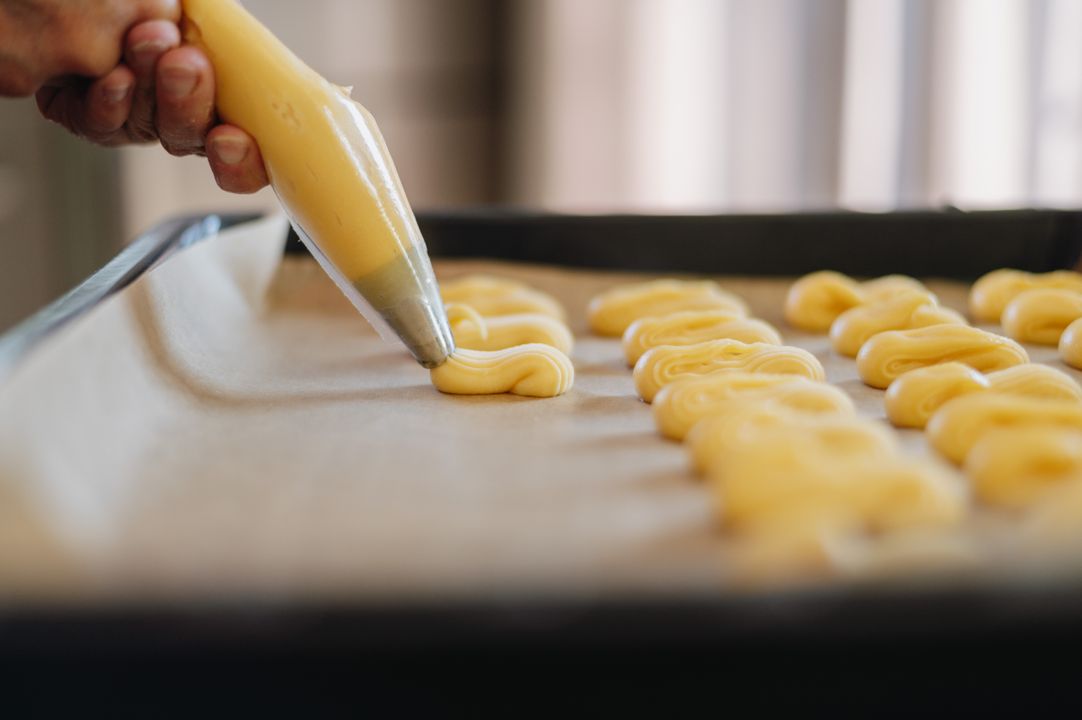
- Collapses after baking — pulled early or oven door opened before walls set; bake to deep golden-brown, don’t peek for 20-25 min
- Fails to puff at all — dough too dry (over-reduced panade) or too wet (excess egg); dough was too hot when piped
- Soggy interior — oven too hot; exterior browns before interior moisture evaporates
- Dense, not hollow — panade over-reduced; not enough water left to generate sufficient steam
Source: FoodCrumbles; Joe Pastry, choux troubleshooting guides
If your shells collapse chronically despite correct baking time, a known professional fix is increasing the proportion of egg white relative to whole egg — extra egg white adds rigidity to the puff walls without adding the fat that softens them (Joe Pastry, 2014). Half the recommended egg quantity specifically produces a weak, inflexible dough that can’t expand properly — this is one of the few pastry doughs where under-measuring egg has an immediate, visible structural consequence rather than just a flavour one.
artisanal cookies: the science behind texture →
Isn’t it strange that the fix for a fragile pastry is more egg, not less liquid overall? That’s the counterintuitive part most first-time choux bakers get wrong — they assume a collapsed shell needs a stiffer dough, when it usually needs a stronger one.
Is Eggless Choux Pastry Actually Possible?
Choux pastry is genuinely difficult to make eggless, and that’s worth stating plainly rather than offering a false easy swap. Unlike most pastries, where eggs mainly add richness, eggs in choux perform a structural, load-bearing job — they’re a large part of what allows the dough to expand and hold its puffed shape at all (VegNews).
Aquafaba — the starchy liquid from cooked or canned chickpeas — is the most commonly tested substitute, since whipped aquafaba can mimic some of an egg white’s protein structure. But aquafaba is mostly water, with far less protein and fat than egg, so most working aquafaba-based choux recipes also add baking powder to compensate for the lost lift (Nora Cooks). Even developers who eventually land a workable version describe the results candidly as “not quite as fluffy and light as the original” after multiple failed attempts.
Citation Capsule: Eggs in choux pastry serve a structural function, not just an enrichment one, which is why aquafaba-based substitutes — the most common documented workaround — typically require added chemical leavening and still produce a noticeably less crisp, less puffed result than an egg-based version (Nora Cooks).
For Jain or strict-vegetarian kitchens where eggs are off-limits entirely, this is one of the rare French techniques worth being upfront about: puff pastry is naturally egg-free and travels well to any Indian kitchen, but choux does not have an equally reliable eggless version yet. Set that expectation before attempting a large-batch eggless eclair order.
Jain root vegetable substitutes in the professional kitchen →
What Is the Real History Behind Choux Pastry?
The popular Catherine de Medici origin story — that her Florentine chef Pantanelli introduced choux to the French court in 1540 — is widely repeated but explicitly disputed by historians, since choux-like “poupelins” are documented in French, English, and German cookbooks well before that date (Wikipedia, “Choux pastry”, citing Potter, 2003). It’s a good story. It just isn’t the accurate one.
The technique closest to the modern method was developed in the 18th century by royal chefs including Jean Avice, who served in Marie-Antoinette’s court, with further refinement credited to Antonin Carême in the 19th century (Wikipedia, “Choux pastry”) — the same Carême whose broader influence shaped French pastry technique across multiple forms, not just choux. The name itself comes from chou, French for cabbage, describing the pastry’s irregular, cabbage-like puffed shape once baked.
couverture vs compound chocolate →
Chef Monila Surana teaches choux as the pastry that rewards patience over precision instruments — there’s no thermometer reading that tells you the panade is ready the way there is for tempering chocolate. You learn it by watching the dough pull cleanly away from the pan sides and leave a thin film on the bottom, exactly the way generations of pastry cooks learned it before digital tools existed at all.
Ready to learn from expert chefs? Explore Courses at Florence Academy
Frequently Asked Questions
Why does choux pastry puff without yeast or baking powder?
Choux relies entirely on steam. The dough’s high water content turns to steam in the oven, and a gluten-and-gelatinized-starch network — built during the stovetop cooking stage — traps that steam inside a flexible shell, forcing it to expand rather than escape.
Why did my choux pastry collapse after baking?
Collapse almost always means the shells were pulled from the oven before the walls fully set and dried. Opening the oven door early releases steam before the structure is rigid enough to hold its shape. Bake until deep golden-brown, and don’t open the door for at least the first 20-25 minutes.
Can you make eggless choux pastry?
It’s genuinely difficult, unlike most pastries. Eggs provide structural lift in choux, not just enrichment, so removing them changes the outcome significantly. Aquafaba is the closest documented substitute, but it’s mostly water and typically needs added baking powder to compensate — the result is noticeably less crisp and puffed than an egg-based version.
What is the difference between an eclair, a profiterole, and a cream puff?
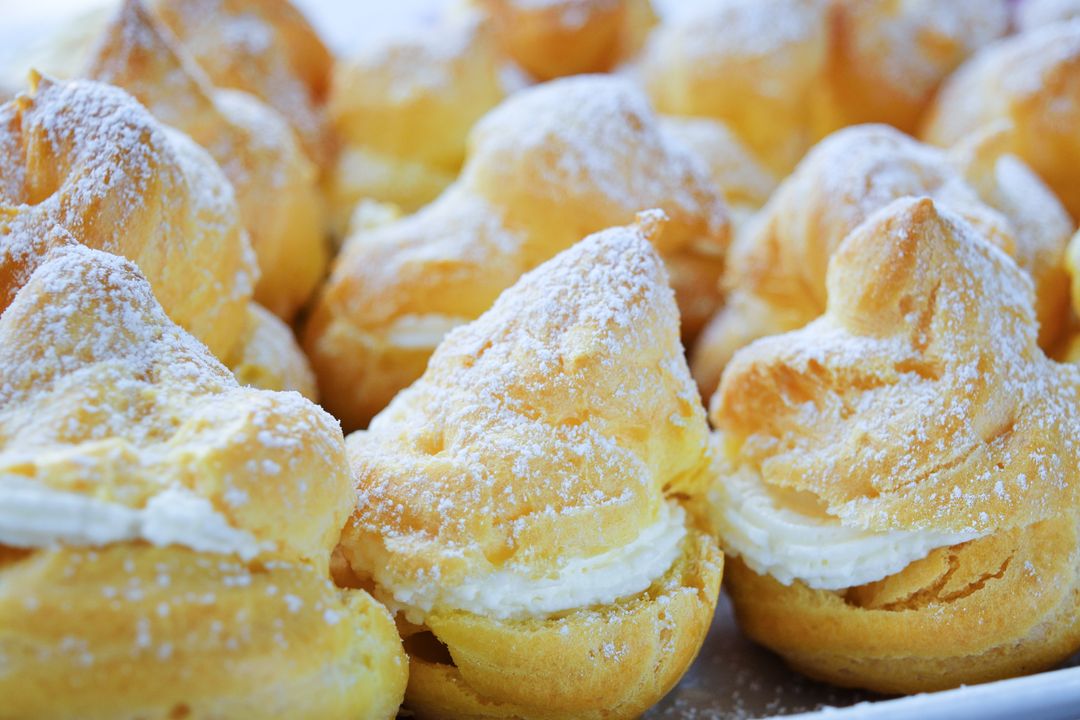
All three use the same choux dough. Eclairs are piped long and filled with pastry cream, then glazed on top. Profiteroles are small round puffs, usually filled with ice cream or cream and served with sauce poured over. Cream puffs are round like profiteroles but typically filled with whipped cream or pastry cream and simply dusted with sugar.
French macaron troubleshooting →
Steam, Timing, and Nothing Else
Choux pastry rewards understanding over shortcuts. Once you know that the entire rise depends on trapped steam, every failure mode makes sense: dough too dry means not enough steam to generate; oven door opened too soon means the steam escapes before the walls can hold their own shape; too little egg means the structure can’t stretch to contain what steam there is.
That’s also why it’s one of the more honest pastries to teach — there’s no way to fake your way through a panade that hasn’t cooked long enough, and no substitute that fully replaces what egg does here. Learn the fundamentals once, and eclairs, profiteroles, and cream puffs all become the same recipe wearing different shapes.
If you want hands-on practice with choux and other French pastry fundamentals under a working chef’s eye, explore the Diploma in Artisanal Bakery & Patisserie at Florence Academy, Ahmedabad’s leading culinary institute.
Have questions? Chat with us on WhatsApp — we respond fast.
Written by Chef Monila Surana, Managing Partner and Lead Culinary Educator at Florence Academy of World Cuisines, Ahmedabad, with 18 years of professional culinary education experience.


