

Of all the pastries a home baker can attempt, croissants are the most technically demanding. Not because the ingredients are exotic, but because the process is mercilessly precise. Butter must stay below 32°C at all times. Room temperature must stay below 20°C throughout lamination. A single warm minute can collapse weeks of effort. Research from culinary schools consistently shows that lamination failure, not flavour or shaping, accounts for the majority of home croissant failures. This guide breaks down exactly what’s happening inside the dough at every stage, where things go wrong, and how to fix them before your next batch.
Key Takeaways
– Croissant lamination produces 27 distinct butter layers through three successive folds.
– Butter must stay between 14-16°C during lamination; above 20°C it begins merging with dough.
– European-style butter at 82-84% fat creates cleaner, drier layers than standard 80% butter (King Arthur Baking, 2023).
– In Indian kitchens during monsoon season, even AC-cooled rooms at 24°C can soften butter faster than expected.
– Proper proof temperature sits at 24-26°C; above 27°C, butter leaks and layers fuse.
What Is Lamination and Why Does It Make Croissants So Hard to Get Right?
Lamination is the process of folding cold butter repeatedly into dough to create 27 distinct, alternating layers. According to food science research published by the Institute of Food Technologists, butter begins to soften and lose its distinct plasticity above 32°C, meaning a work surface that’s even slightly warm can fuse layers that took hours to build (IFT Food Technology Journal, 2022).
Each fold multiplies the layers. Three letter folds produce 3 x 3 x 3 = 27 layers. The butter must remain solid, sheet-like, and separate from the dough. The moment butter warms past its plastic range, it stops behaving like a distinct sheet. It starts blending into the dough instead.
So the real challenge isn’t folding. It’s temperature management. Your room, your hands, your work surface, your dough, and your butter must all stay cold simultaneously. In a European winter kitchen, this happens naturally. In an Indian kitchen in July, it requires planning.
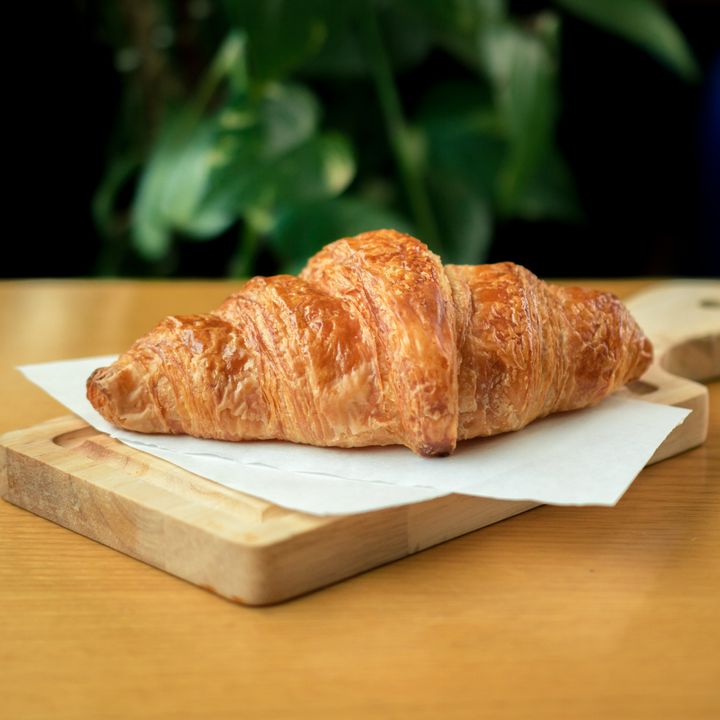
Which Butter and Flour Make the Biggest Difference?
The fat content of butter determines how much water gets introduced into your dough during lamination. European-style butter at 82-84% fat contains significantly less water than standard butter at 80%, which means cleaner steam pockets during baking and crisper, more defined layers (King Arthur Baking, 2023). Less water in the butter means less moisture bleeding into the dough layers between folds.
In India, Amul unsalted butter at approximately 80% fat is widely available and workable. President or Elle & Vire, when available at specialty stores, perform noticeably better. FSSAI regulations define table butter as containing a minimum of 80% milk fat (FSSAI Food Safety and Standards Authority of India, 2023), so standard Indian packaged butter sits at the lower acceptable threshold. Worth knowing before you buy.
Flour matters just as much. You need strong bread flour with a protein content of 11-13%. That protein forms the gluten network that holds layers under the mechanical stress of repeated rolling. All-purpose flour at 9-10% protein doesn’t build enough gluten strength. Under lamination pressure, the dough tears rather than stretches.
croissants and Danish pastry techniques course →
How Do You Make the Butter Block Without It Cracking?
The butter block is where most first-time bakers lose the plot. It needs to be cold enough to stay solid through folding, but pliable enough to bend without fracturing. The target temperature is 14-16°C. At that range, butter behaves like stiff but flexible leather, not like frozen clay.
Start by cutting cold butter into slabs and arranging them into a rough square on a sheet of parchment. Fold the parchment around it to form a 20x20cm envelope. Then beat it flat with a rolling pin using firm, even strokes. This process is called “beurrage” in French pastry technique. The goal is to work the butter until it’s uniformly flat and smooth at the corners, with no lumps or air pockets.
Two failure signals to watch for. If your butter cracks and shatters when you beat it, it’s too cold. Let it sit at room temperature for five minutes. If it squishes into soft, greasy smears rather than holding its shape, it’s too warm. Return it to the fridge for 10 minutes. The pliability window is narrow.
: Chef Monila Surana, who has been teaching pastry technique at Florence Academy for 18 years, describes the first time lamination truly clicked for her: “I had been fighting the dough for three batches. Then one day the butter was exactly right, and the dough started rolling out like fabric instead of fighting back. You can feel the difference in your hands. The dough stops resisting. That’s when you know the temperature is right.”
| Temperature | State | Best Used For |
|---|---|---|
| 10°C (fridge-cold) | Very firm, breaks when pressed | Shortcrust pastry rubbing, pie dough |
| 14°C (cold room temp) | Pliable, bends without cracking | Croissant & puff pastry lamination |
| 16°C (ideal soft) | Leaves indent without resistance | Creaming for cakes and cookies |
| 20°C (warm kitchen) | Noticeably greasy, loses structure | Acceptable for quick breads; avoid cakes |
| 32°C+ (melted) | Fully liquid, fat separates | Brown butter sauces, finishing only |
Source: IFT Food Technology Journal 2022
The 3-Fold Process: What Each Turn Does to the Layers
Three folds, done correctly, build the 27-layer structure that gives a croissant its honeycomb crumb. Each fold also develops gluten, which is why rest periods between folds aren’t optional. Skip the rest and the dough snaps back, tears, or thins unevenly.
The sequence runs like this. Place the butter block in the centre of the rolled dough and fold the sides over it like an envelope. This is your first fold, also called the “lock-in.” Roll it out gently to roughly 60x20cm, then perform a letter fold: fold the bottom third up, the top third down. Wrap it and refrigerate for 30 minutes.
After the first rest, roll out again and repeat the letter fold. Back into the fridge for another 30 minutes. Then the third letter fold, followed by a final 30-60 minute rest before shaping. During each rolling session, you’re looking for the dough to feel even and slightly elastic, not sticky or warm.
Temperature checkpoints are non-negotiable. If you see butter starting to show through the dough surface as a greasy smear, stop immediately. Wrap and refrigerate for 20 minutes before continuing. Butter showing through means it has softened enough to merge with the dough. At that point, you’re not building layers anymore.
puff pastry folding techniques →

What Goes Wrong? The 6 Most Common Croissant Failures
Most croissant failures trace back to a single temperature error, not a technique error. Understanding what each failure mode looks like and what caused it helps you diagnose your batch before the next attempt. Here are the six failures we see most often, and exactly what drives each one.
: In an Indian kitchen, humidity and ambient heat are the biggest enemies of lamination that most Western baking guides simply don’t address. During June through September, even an air-conditioned kitchen maintained at 24°C can soften butter faster than a European bakery kitchen at the same setting, because humidity affects how quickly heat transfers into the dough surface. The practical fix: chill your work surface with ice packs before rolling, work in strict 10-minute rolling windows with a timer, and return the dough to the fridge between every single step. Don’t trust your eyes alone. Trust the clock.
Layers Fusing Together
You slice into the croissant and see bread rather than distinct laminated layers. This happens when butter was too warm during one of the folds. Once butter merges with dough during folding, you can’t recover those layers in the oven. Prevention is the only cure: keep butter at 14-16°C throughout, and refrigerate immediately if the dough feels greasy or soft.
Dough Tearing During Rolling
If the dough tears, fights back, or won’t extend evenly, gluten has tightened under the stress of rolling. This is normal; gluten contracts when worked. The fix is simple: wrap and rest the dough in the fridge for at least 20-30 minutes. Gluten relaxes with time and cold. Forcing the roll after tearing makes it worse, not better.
No Honeycomb Crumb
A dense, closed crumb without the characteristic open honeycomb structure means the croissant was underbaked. The internal temperature must reach at least 90°C for the layers to set and the steam pockets to stabilise. A probe thermometer inserted from the side is the most reliable check. Visual browning alone isn’t enough.
Flat, Dense Croissants
If your shaped croissants come out flat and heavy rather than puffed and airy, butter melted during the proof stage. Proof temperature must stay below 27°C. Above that, the butter softens, leaks out of the layers, and the dough loses the structural fat channels that create lift during baking. A cool spot in the kitchen or a switched-off oven with just the light on can work as a proof environment.
Greasy Bottom
A pool of grease under the croissants after baking means butter leaked out during the oven stage. This is almost always caused by butter that was too warm going in, or butter with too low a fat percentage. Both allow excess moisture to escape as the croissant heats. Switching to higher-fat butter and ensuring the shaped croissants are cold when they go into the oven reduces this significantly.
Pale Exterior
A croissant that comes out pale and soft, not golden and crisp, usually has two causes. Either the oven temperature is too low (target 190-200°C, fan-assisted) or the egg wash was applied too thickly, forming a coating that steams instead of caramelises. Apply egg wash in a thin, even layer with a soft pastry brush. For Jain bakers avoiding eggs, a thin milk wash produces a less glossy but acceptable golden colour.
How Do You Shape and Proof Croissants Correctly?
Shaping accuracy matters more than most home bakers expect. Cut isoceles triangles with a base of 9-10cm and a height of approximately 20cm. A longer triangle means more rolls and a tighter spiral, which traps more layers at the centre. King Arthur Baking’s laminated dough guides confirm that a 20cm triangle height is the standard for a classic French croissant shape (King Arthur Baking, 2023).
Before rolling, make a 1cm notch at the centre of the base. This allows the two base corners to splay slightly as you roll, creating the characteristic curved horn shape. Roll from the base toward the tip with gentle but consistent tension. Don’t press down hard. The motion is more of a rolling stretch than a flattening pressure.
Place shaped croissants on a lined tray with the tip tucked underneath. This stops them unrolling during proof. Proof at 24-26°C for 2-3 hours. A properly proofed croissant should jiggle visibly when you shake the tray. You should also be able to see the distinct layer lines through the surface.
An overnight cold proof in the refrigerator after shaping is worth the extra planning. The slower, cooler fermentation builds noticeably better flavour than a same-day proof, and cold-proofed croissants are easier to egg-wash cleanly. Pull them from the fridge, egg-wash immediately, and bake straight from cold.
croissant workshop at Florence Academy →
Ready to learn from expert chefs? Explore Courses at Florence Academy
Frequently Asked Questions
Can I Make Croissants at Home Without a Sheeter?
Yes. A heavy rolling pin and a cold marble or granite surface work well for home baking. The key is working quickly in 10-minute rolling windows and returning the dough to the fridge between each session. According to King Arthur Baking’s home baker guides, most professional bakers learned on rolling pins (King Arthur Baking, 2023). A sheeter speeds the process but doesn’t improve results if butter temperature is wrong.
How Many Layers Does a Proper Croissant Have?
A standard croissant uses three letter folds, producing 27 distinct butter layers. More folds don’t automatically produce a better croissant. Beyond 27 layers, butter and dough begin to merge rather than separate, losing the definition that creates the honeycomb crumb structure. Three folds is the professional standard for a reason: it’s the optimal balance of layers versus layer integrity.
Can I Use Vegetable Shortening Instead of Butter for Lamination?
Technically yes, but the result will differ in both structure and flavour. Vegetable shortening has a higher melting point, which makes lamination physically easier to manage in a warm kitchen. However, shortening lacks the water content of butter. That water converts to steam during baking, and steam is what physically pushes the layers apart. Butter creates a flakier, richer croissant that shortening can’t replicate.
How Do I Know When Croissants Are Properly Proofed?
A properly proofed croissant jiggles visibly when you gently shake the baking tray. The dough looks clearly puffed, and you can see the layer lines through the surface. Overproofed croissants collapse in the oven as the gluten structure can no longer hold the gas. Underproofed croissants are dense and don’t spring open. The jiggle test is the most reliable non-equipment check available to home bakers.
The Honest Truth About Making Croissants at Home
Croissants reward patience over raw skill. Every technique in this guide is learnable. But it takes multiple attempts before the process starts to feel natural, because you’re training your hands to read signals: the way cold butter resists the pin, the moment gluten relaxes and the dough finally extends, the specific jiggle that tells you the proof is done. None of that comes from reading alone.
In Florence Academy’s pastry classes, students working through croissant lamination for the first time typically need three complete practice batches before consistent results appear. Chef Monila Surana notes that the shift usually happens not with technique but with temperature awareness: once students start instinctively reaching for the fridge rather than pushing through, results improve immediately.
Give yourself two to three complete batches before judging the technique. Take notes after each one. Track your room temperature, your butter temperature at each fold, and your proof conditions. The data from failed batches is the most valuable resource you have.
For bakers who want to compress that learning curve significantly, structured pastry instruction matters. Working alongside an experienced chef who can feel your dough, read your butter block, and catch temperature errors in real time shortens the learning arc from months to days.
Have questions? Chat with us on WhatsApp — we respond fast.
Chef Monila Surana has taught pastry and baking at Florence Academy of World Cuisines in Ahmedabad for 18 years, with expertise in laminated doughs, French pastry technique, and adapting European baking methods to Indian kitchen conditions.


