
French macarons are widely considered the most technically demanding cookie in classical patisserie. Bridor, one of Europe’s leading bakery manufacturers, identified macarons as a standout confectionery trend for 2024 precisely because of their appeal — and their difficulty (Bakery and Snacks / Bridor, February 2024). Most home bakers report failures across their first three to five batches. That’s not a reflection of skill — it’s a reflection of how many things have to go right simultaneously.
The good news: every macaron problem has a specific cause. Cracked tops, hollow shells, flat feet, sticky bottoms, weeping filling — none of them are random. This guide diagnoses each problem and gives you the exact fix. We’ve also included the full eggless aquafaba method for Indian bakers working in a 100% vegetarian or Jain kitchen.
Key Takeaways
– Most macaron failures trace back to four variables: batter consistency (macaronage), oven temperature, humidity, and resting time
– Cracked tops = oven too hot or insufficient skin formation; hollow shells = over-macaronage or too much heat
– Eggless macarons are achievable with reduced aquafaba — Florence Academy’s Eggless Macarons Workshop covers the full technique
– Macarons improve with maturation: filled shells refrigerated for 24 hours develop the ideal chewy-crispy texture
Why Are French Macarons So Difficult to Get Right?
Macarons demand precision at every stage. A difference of 5°C in oven temperature, 60 seconds of extra mixing, or 15 minutes less resting time changes the outcome completely. That sensitivity is what makes them both frustrating and rewarding.

The shell is made from four ingredients: almond flour, icing sugar, egg whites, and caster sugar. Each plays an exact role. Almond flour provides structure and fat. Icing sugar sweetens and stabilises. Egg whites form the protein network that creates the shell. Caster sugar stabilises the meringue. Changing the ratio of any one of these — or the process — cascades into visible problems.
At Florence Academy, we’ve observed that humidity is the most underestimated variable among students learning macarons in Ahmedabad. During monsoon months (June–September), we recommend reducing the resting time to 20–25 minutes and increasing oven temperature by 5°C to compensate for ambient moisture. What works in December doesn’t automatically work in July.
Citation Capsule — Macaron Difficulty
French macarons have been widely identified by professional patissiers and baking educators as the most technically challenging cookie in classical patisserie — requiring simultaneous precision in ingredient ratios, meringue stability, macaronage technique, resting conditions, and oven calibration. Bridor’s 2024 trend report highlighted macarons as a growing commercial opportunity specifically because of the skill barrier that limits home production and increases perceived value. (Bakery and Snacks / Bridor, February 2024)
Ready to learn macaron technique with hands-on chef guidance? Explore Courses at Florence Academy →
Why Do My Macaron Tops Crack?
Cracked tops are the most common macaron problem, and they almost always come down to two things: oven temperature and resting.
Cause 1: Oven temperature too high. Above 150°C fan (165°C conventional), the outer shell sets and rises faster than the steam can escape, causing pressure cracks. Each oven behaves differently — a digital oven thermometer is not optional for macaron baking.
Fix: Reduce to 145°C fan (155°C conventional). Bake one test tray before committing your full batch.
Cause 2: Insufficient resting. Piped macarons need to form a dry skin before going in the oven. This skin allows steam to escape through the base (creating feet) rather than splitting the top.
Fix: Rest piped shells for 30–45 minutes at room temperature. They’re ready when you can lightly touch the surface without any batter sticking to your finger. In humid conditions (during Ahmedabad’s monsoon), rest for up to 60 minutes.
Cause 3: Air pockets in the batter. Under-macaronage (under-mixing) leaves air bubbles in the batter. These expand in the oven and crack the shell.
Fix: After folding, tap the tray firmly on the counter 3–4 times to release air bubbles before resting.
Why Are My Macarons Hollow Inside?
Hollow macarons look perfect from outside but are empty inside rather than chewy. The cause is almost always one of three things.
Cause 1: Over-macaronage. Mixing too long deflates too much air from the meringue. The batter spreads too wide, the shell rises too quickly in the oven, and the inside collapses before it sets.
Fix: Stop mixing when the batter flows off the spatula in a continuous ribbon and folds back into itself within 10 seconds (the “lava flow” test). Count your folds: typically 40–50 folds total from start to finish.
Cause 2: Oven temperature too high. The outside sets before the inside can structure itself.
Fix: Lower temperature and extend baking time by 2–3 minutes.
Cause 3: Egg whites not aged. Fresh egg whites contain too much water. Aged egg whites (separated and left uncovered in the refrigerator for 24–48 hours) have evaporated some moisture, producing a more stable meringue.
Fix: Age your egg whites at least 24 hours in advance, covered loosely with cling wrap.
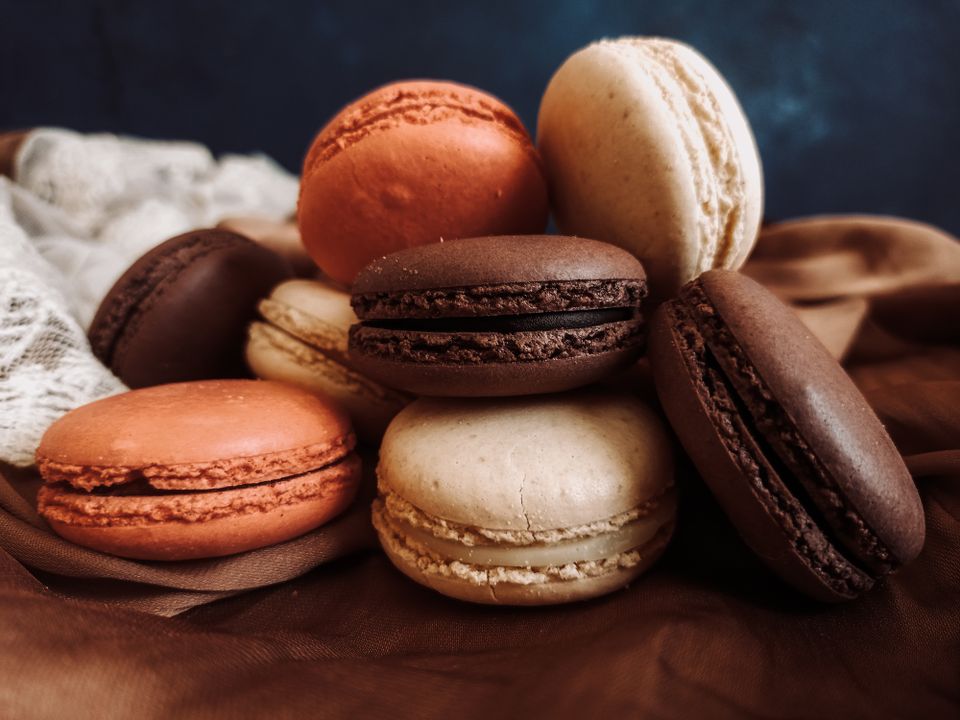
In our macaron workshops in Ahmedabad, we’ve found that students consistently over-mix rather than under-mix. The instinct is to keep folding until the batter looks “smooth” — but smooth-and-shiny is the look you want, not perfectly uniform. Small streaks of meringue visible in the batter when you stop is not a problem. Stop earlier than you think you need to.
Why Aren’t My Macarons Developing Feet?
The ruffled “foot” at the base of each macaron is the visual signature of a successful bake. No feet means something went wrong in either the batter or the oven setup.
Cause 1: Batter too thick (under-macaronage). Stiff batter doesn’t spread enough to create the foot structure.
Fix: Fold a few more times and test again. The batter should flow — not pour, but flow.
Cause 2: Oven temperature too low. Feet form because the base of the shell heats faster than the top, causing lateral spread before the shell sets. Too low a temperature eliminates this differential.
Fix: Increase temperature by 5–10°C. Ensure the oven is fully preheated for at least 15 minutes.
Cause 3: Thin baking tray. Thin trays heat unevenly and too quickly, not giving the macaron time to develop feet before setting.
Fix: Use a heavy aluminium baking tray, or double-stack two standard trays to slow base heat transfer.
Why Is My Macaron Filling Weeping or Making the Shell Soggy?
Weeping filling is the post-bake failure that appears after assembly. The filling softens the shell from inside until it becomes chewy-soggy rather than chewy-crispy.
Cause 1: Filling too soft. Ganache with insufficient chocolate ratio, or buttercream with too much cream, releases moisture as it sits.
Fix: For dark chocolate ganache, use a 2:1 chocolate-to-cream ratio by weight. For milk chocolate, use 2.5:1. For white chocolate, 3:1. These ratios produce a ganache firm enough to mature without weeping.
Cause 2: Macarons stored in a warm or humid environment. Room temperature storage in Ahmedabad’s summer causes even well-made filling to soften faster.
Fix: Always refrigerate filled macarons. Store in an airtight box, not an open plate.
Cause 3: Shells not fully baked. Slightly underdone shells retain internal moisture that transfers to the filling.
Fix: Test doneness by gently pressing the side of a macaron. It should feel firm and not wobble. Add 2 more minutes if uncertain.
Making Eggless Macarons with Aquafaba
Florence Academy’s curriculum is 100% vegetarian, and we teach an eggless macaron technique using aquafaba — the liquid from canned chickpeas, a substitution method extensively documented by King Arthur Baking and tested across meringue, mousse, and buttercream applications. It’s the most structurally reliable egg white substitute for meringue-based bakes.
Aquafaba preparation:
Pour the liquid from one can of chickpeas into a small saucepan. Simmer on low heat until reduced by 30–40% (from roughly 200ml to 120–130ml). Cool completely before using. This thickening step is critical — unreduced aquafaba contains too much water to form a stable meringue.
Substitution ratio:
3 tbsp reduced aquafaba = 1 large egg white (approximately 30g)
Whipping:
Aquafaba takes longer to whip than egg whites — expect 10–12 minutes on high speed to reach stiff peaks. Add cream of tartar (¼ tsp per egg white equivalent) to stabilise.
What changes:
– Feet are slightly less defined but still visible
– Shell has a marginally more fragile texture
– Colour is slightly less white (aquafaba has a faint yellowish tone)
– Flavour is identical once filled
Florence Academy’s Eggless Macarons Workshop covers the complete aquafaba technique with hands-on practice.
French Macaron Troubleshooting Quick Reference
| Problem | Most Likely Cause | Fix |
|---|---|---|
| Cracked tops | Oven too hot / no skin formed | Lower temp; rest 30–45 min |
| Hollow shells | Over-macaronage | Stop mixing at lava-flow stage |
| No feet | Under-macaronage / low oven temp | More folds; raise temp 5°C |
| Sticky bottoms | Under-baked / tray too thin | Bake longer; use heavy tray |
| Wrinkled tops | Batter too wet / meringue unstable | Age egg whites; fold less |
| Weeping filling | Ganache too soft / humid storage | Adjust chocolate ratio; refrigerate |
Have questions? Chat with us on WhatsApp — we respond fast.
For deeper reading on egg foam science and baking chemistry, ScienceDirect publishes peer-reviewed research on meringue foaming properties, oven dynamics, and the role of moisture in shell formation.
Frequently Asked Questions
How do I know when macaron batter is perfectly macaronaged?
The batter should flow off a spatula in a thick, continuous ribbon and disappear back into itself within 8–10 seconds. If it sits in peaks without flowing, keep mixing. If it pours like pancake batter, it’s over-mixed. The correct consistency is often described as “lava” — slow, thick, and shiny.
Why do my macarons stick to the parchment paper?
Sticking means the macarons are under-baked. Add 2–3 minutes more baking time and test again. When properly done, macarons release from parchment cleanly with gentle lifting once they’ve cooled. Never try to remove them hot — they will always stick when warm regardless of doneness.
How long do macarons last once filled?
Filled macarons keep refrigerated for 5–7 days in an airtight container. They peak at 24–48 hours after filling — the shells soften slightly from the moisture in the filling, reaching the ideal chewy-crispy texture. Unfilled shells keep at room temperature in an airtight tin for up to 1 week.
Do I need a food processor to make macaron shells?
A food processor for the almond flour and icing sugar (to achieve extra-fine texture) is recommended but not essential. You can sift the mixture multiple times instead. The key is removing any coarse almond pieces — these create bumpy shells. Sifting twice through a fine mesh sieve achieves a similar result.
Can I freeze macarons?
Yes — both filled and unfilled macarons freeze well for up to 3 months in a sealed container. Thaw overnight in the refrigerator, then bring to room temperature for 20 minutes before serving. Texture after freezing is almost indistinguishable from fresh.
Build the Skill, Not Just the Recipe
Macarons become consistent once you understand what each variable controls. The recipe itself isn’t the challenge — the technique is. If you want to master macarons with hands-on guidance from professional pastry chefs, Florence Academy’s courses give you that practice environment in Ahmedabad.
Join 2,000+ students who’ve trained with expert chefs at Florence Academy, Ahmedabad.
Explore Courses at Florence Academy →
Chat with us on WhatsApp — we respond fast.
See also: French Macaron Course at Florence Academy | Eggless Macarons Workshop | Why Your Cakes Sink in the Middle — 7 Baking Mistakes Fixed


