
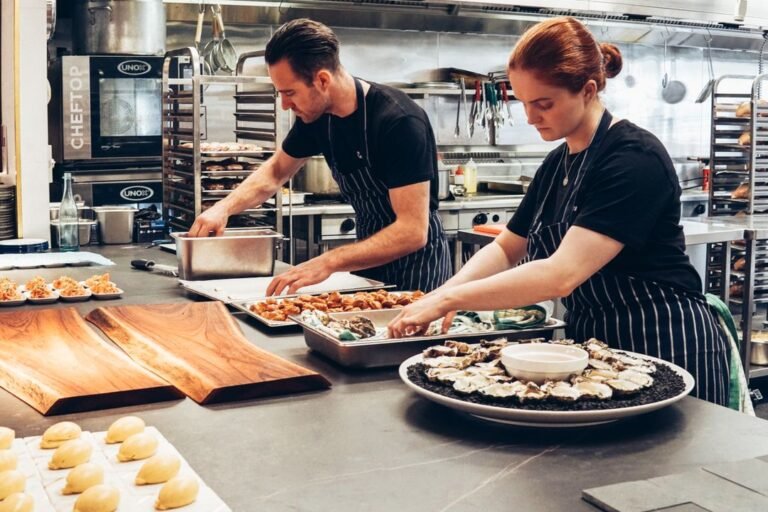
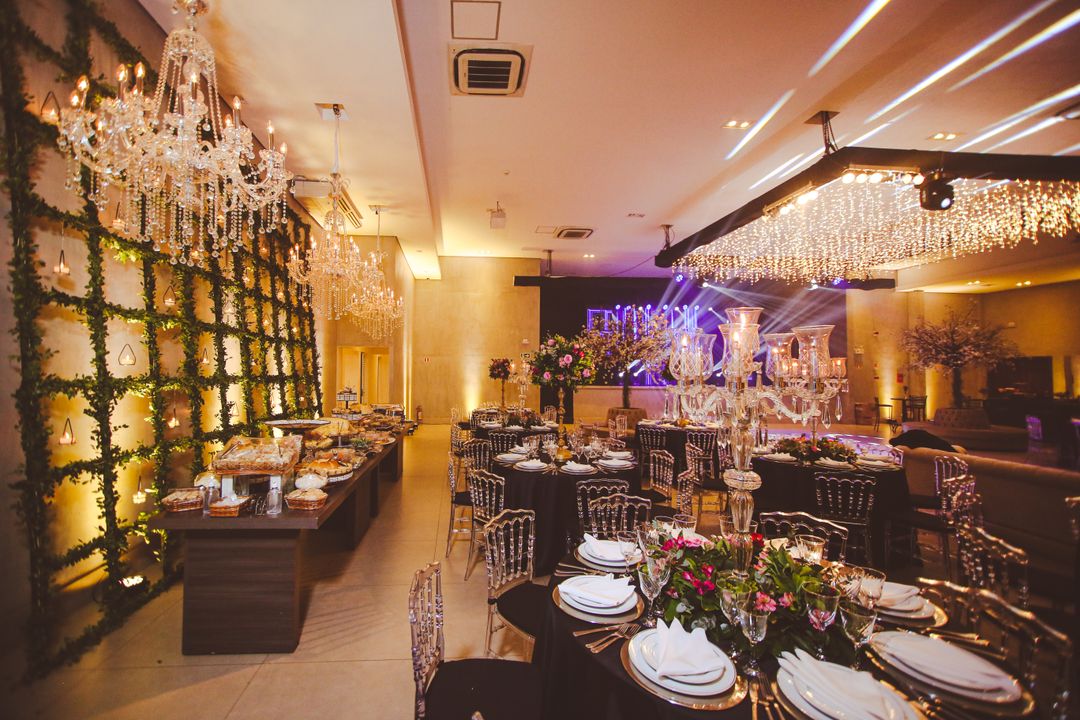
Walk past any hotel function room in Ahmedabad on a December evening and you’ll see the same thing: four hundred plates going out inside twenty minutes. The chef who made that happen isn’t a restaurant chef working faster. Banquet cooking is a separate discipline with its own arithmetic, and India’s hospitality sector is projected to grow from around US$24.61 billion in 2024 to US$31.01 billion by 2029 (IBEF, Ministry of Commerce and Industry). Function rooms are a big part of that.
Key Takeaways
– A banquet chef career is built on volume mechanics — yields, holding, buffet flow — not on a bigger version of restaurant cooking.
– India’s wedding catering market alone was valued at USD 16.19 billion in 2025 and is projected to reach USD 28.63 billion by 2032 (MarknTel Advisors).
– Cooking for 500 scales non-linearly: seasoning, thickeners and holding times all behave differently in bulk.
– In Gujarat, running separate Jain and vegetarian counters cleanly is a core banquet skill, not an add-on.
What Does a Banquet Chef Actually Do?
They own food for functions rather than for a dining room. In 2023, premium Indian hotels ran occupancy of 70–72% with average room rates above ₹6,000 a night, and hotel revenues rose 20% over 2022 with operating margins above 30% (IBEF, Ministry of Commerce and Industry). Function business is a major reason those margins hold.
The day looks nothing like restaurant service. A restaurant chef cooks to order across a long evening; a banquet chef cooks to a deadline, then holds.
That single word — hold — is where most of the craft sits. Food is finished before guests arrive, kept at temperature, and served over a window that might run 90 minutes.
So what does the job actually involve day to day? Menu costing against a per-head budget, yield planning so 400 covers don’t become 340, equipment allocation, and a service plan that tells eight people exactly when to move.
It’s closer to production management than to à la carte cooking, which is exactly why some excellent restaurant cooks struggle with it — and why some average ones turn out to be superb banquet chefs.
If you’re still deciding whether a culinary career is the right move at all, our guide to how to become a chef in India covers the entry routes before you specialise into banquet work.
Why Is a Banquet Chef Career in Demand in India Right Now?
Because the functions keep coming. India’s wedding catering services market was valued at USD 16.19 billion in 2025 and is projected to reach USD 28.63 billion by 2032, a CAGR of 12.08% across 2026–32 (MarknTel Advisors, 2025). Weddings are only part of banquet work, but in Gujarat they’re the anchor.
Note what that figure is and isn’t. It’s a market-research projection, not a government statistic, so read it as direction and scale rather than a precise forecast.
The seasonality is real too, and it shapes the job. Gujarat’s function calendar clusters heavily around the winter wedding months and the post-Diwali stretch, which means banquet teams run flat out for weeks and then breathe.
Does that make it unstable work? Not usually — hotels keep banquet brigades on payroll year-round and redeploy them through quieter months, which is a meaningful advantage over freelance catering.
How Is Cooking for 500 Different From Cooking for 50?
It doesn’t scale by multiplication. This is the single biggest thing culinary graduates get wrong, and it’s why hotels test for it rather than assume it.
| What changes | Cooking for 50 | Cooking for 500 |
|---|---|---|
| Seasoning | Scales roughly with volume | Salt and chilli scale sub-linearly; over-seasoning is the classic bulk error |
| Thickeners | Behave predictably | Starches keep thickening in the pot; gravies set as they hold |
| Holding | Minimal — plate and serve | The dominant variable; dishes must survive 45–90 minutes |
| Equipment | Range and pans | Bulk cookers, tilting pans, chafing capacity, transport |
| Timing | Continuous across service | One deadline, everything landing together |
| Failure mode | One plate returns | Four hundred guests get the same problem at once |
That last row is the honest reason banquet work carries pressure. A restaurant mistake affects one table; a banquet mistake is served to the whole room simultaneously.
So why doesn’t seasoning just multiply? Partly because salt perception isn’t linear, and partly because a bigger pot means less surface evaporation and a longer cook, both of which concentrate what’s already there. Experienced banquet chefs season low, hold, then correct at the end.
Equipment changes the cooking too, not just the quantity. A tilting bratt pan heats differently from a range burner, and a dish developed on one and cooked on the other rarely behaves the same way.
Our finding: Chef Monila Surana, who has spent 18 years running kitchens and curriculum at Florence Academy, notes that the most common failure in student banquet exercises isn’t cooking at all — it’s finishing dishes too early and letting them sit. The food is correct at 6pm and tired by 7:30.
Which dishes survive the wait? Braises, dals, gravies with fat and body, anything already designed to sit. Which don’t? Crisp textures, delicate greens, and most things finished with dairy at the last second.
Designing a menu around that constraint, rather than fighting it, is most of what separates a banquet chef from a cook working at volume.
Here’s the arithmetic made concrete. Plan a paneer dish for 400 guests at a buffet and you don’t order 400 portions — you order for roughly 60% uptake on that item, because guests are choosing between eight dishes. Get the uptake assumption wrong in either direction and you’ve either wasted a third of the paneer budget or run the counter dry by 8pm.
That estimate isn’t guesswork either. It comes from function history: what this venue, this season, this kind of guest list actually ate last time. Banquet chefs who keep records outperform ones who rely on instinct, every time.
Ready to learn from expert chefs? Explore Courses at Florence Academy →
What Skills Do Hotels Actually Test For?
Yield discipline first, because it’s the one that’s measurable. Hospitality employed 8.8% of India’s workforce in 2019 (HVS, February 2022, citing Ministry of Tourism data), and a large share of those jobs sit in exactly this kind of high-volume operation. If a hotel budgets a function at a fixed per-head cost and your yields run short, the shortfall shows up as either money or empty chafing dishes — and the client sees both.
Four competencies come up again and again in banquet hiring:
Yield calculation. Converting a per-head portion into raw purchase quantity, allowing for trim, shrinkage and the difference between plated and buffet consumption. Buffet guests take more; the allowance has to be built in.
Holding temperature control. Knowing what each dish tolerates, and building a finishing schedule backwards from service time rather than forwards from prep.
Buffet replenishment logic. Small, frequent top-ups keep a counter looking full and food tasting fresh. One enormous tray at the start guarantees a tired counter by the middle of service.
Counter separation. In Gujarat this is not optional. Functions routinely run Jain, vegetarian and non-vegetarian counters at once, with no shared utensils, oil or serving spoons between them.
Is that harder than it sounds? Considerably. It means duplicated equipment, a prep schedule that keeps the streams apart from receiving onwards, and service staff briefed well enough not to move a spoon between counters at the busiest moment of the night.
That last point deserves emphasis for anyone training here. A banquet chef in this market who can’t plan Jain separation into the workflow — separate prep benches, separate oil, labelled service — is not employable at the top venues, however good the cooking is. Our guide to Jain food culture in Gujarat covers the boundaries that separation has to respect.
What Does the Banquet Chef Career Ladder Look Like?
Most banquet chefs come up through the brigade rather than starting there. With a projected national deficit of 1.1 million hospitality workers by 2025 (HVS, February 2022), the ladder moves faster than it used to. The route still runs through general kitchen roles first, with banquet specialisation arriving once you’ve proven you can hold a section under pressure.
| Stage | Typical experience | What you own |
|---|---|---|
| Commis | 0–2 years | Prep, mise en place, learning yields by doing them |
| Chef de Partie | 2–5 years | A section during function service |
| Banquet Sous Chef | 5–8 years | Execution on the day: timing, holding, the service plan |
| Banquet Chef / Head | 8–12 years | Menus, costing, staffing, client conversations |
The timelines vary by property and by how much volume you actually see. Someone in a busy Ahmedabad banquet hotel through two full wedding seasons will progress faster than someone in a quiet property.
We’ve kept salary out of this deliberately, because the site covers it properly elsewhere: see our role-by-role chef salary breakdown and the commis chef career path for the first five years in detail.
Worth knowing: banquet experience travels well. It’s one of the few specialisations that reads equally strongly to hotels, contract caterers and large institutional kitchens.
What stalls people on this ladder? Almost always the jump from Chef de Partie to Banquet Sous. Running a section is a cooking job; running the day is a planning job, and the two need different habits. Chefs who never learn to write a service plan tend to stay one rung below the one they want.
How Do You Get Into Banquet Work From a Culinary Course?
Through hotel placement, mostly, and by asking for the function rooms specifically. The shortage works in your favour here: a Ministry of Tourism study cited by HVS in 2022 put India’s hospitality manpower gap at 2.6 million in 2018 and projected a deficit of 1.1 million by 2025 (HVS, February 2022). Banquet sections are chronically busy and glad of hands.
Diploma graduates who request banquet exposure during industrial training usually get it, simply because nobody says no to help during wedding season. The ones who don’t ask get rotated through the restaurant instead and finish the placement having never seen a 400-cover service.
Three things make a graduate CV read as banquet-ready. Volume numbers — say “executed for 300 covers”, not “assisted in banquet operations”. Named equipment you’ve actually used. And any evidence of yield or costing work, which most fresh graduates simply don’t have.
Our finding: In placement conversations, the students who land banquet roles fastest are rarely the strongest cooks in the batch. They’re the ones who can explain how they’d feed 400 people with three bulk cookers and a 90-minute service window.
For the hiring side of that conversation, our guide to getting placed at ITC Hotels, Marriott and top Gujarat restaurants covers what recruiters look for, and chef specialisations in India explains where banquet sits alongside the classical brigade sections.
If the catering side interests you more than the hotel side, how to cater a wedding in Gujarat covers the same volume problems from an owner’s perspective.
Frequently Asked Questions
What does a banquet chef do?
A banquet chef plans and executes food for large functions – weddings, conferences, corporate events – rather than a la carte restaurant service. The job is built around yields, holding times, buffet replenishment and service timing for hundreds of covers landing at once, not around individual plates.
Is a banquet chef career worth it in India?
The demand is structural rather than seasonal hype. India’s wedding catering services market was valued at USD 16.19 billion in 2025 and is projected to reach USD 28.63 billion by 2032, per MarknTel Advisors. Banquet volume is what fills hotel function rooms between room-night cycles.
How is cooking for 500 different from cooking for 50?
It scales non-linearly. Seasoning does not multiply cleanly, thickeners behave differently in bulk, and holding becomes the dominant variable because food sits before it is eaten. A banquet chef designs dishes that survive 45–90 minutes in a chafing dish, which rules out many restaurant preparations.
What qualifications do you need to become a banquet chef?
Most banquet chefs come up through the brigade rather than entering directly. A culinary diploma plus commis-level hotel experience is the usual route, with NSDC or AHLEI certification helping at the hiring stage. What matters most in interviews is demonstrated volume experience.
Do banquet chefs need to handle Jain and vegetarian counters?
In Gujarat, constantly. Large functions routinely run separate Jain, vegetarian and non-vegetarian counters with no cross-contact of utensils, oil or serving spoons. Planning that separation into the kitchen workflow rather than improvising it on service day is a core banquet skill in this market.
Conclusion
A banquet chef career rewards a specific kind of mind:
- Arithmetic over improvisation — yields, per-head costs, and quantities that have to be right before anyone starts cooking.
- Holding as a design constraint — building menus around what survives 90 minutes, not what plates beautifully at once.
- Sequencing under one deadline — everything landing together, for hundreds of people.
- Counter discipline — in Gujarat, planning Jain and vegetarian separation into the workflow from the start.
If you enjoy the puzzle of feeding a room rather than the theatre of plating, this is the specialisation to chase. Ask for the function rooms during your industrial training and start counting covers.
About the author: Chef Monila Surana is Managing Partner and lead culinary educator at Florence Academy of World Cuisines, Ahmedabad, with 18 years of experience running professional kitchens and designing culinary curriculum.
Want to build these skills hands-on? Our Culinary Foundation Program covers volume technique, costing and kitchen workflow with expert chefs in Ahmedabad. Join 2,000+ students who’ve trained with us.
Call us at +91 6351665305 | +91 8320715588
Have questions? Chat with us on WhatsApp — we respond fast.


