
Commercial mithai shops have professional equipment, speed, and scale. But they don’t have your kitchen and your time. The best argument for making sweets at home isn’t nostalgia — it’s control. You choose the quality of ghee, the freshness of the khoya, the amount of sugar. You decide whether to use jaggery or refined sugar, organic cashews or standard ones. No one is cutting corners to meet a production deadline.
This guide covers 8 traditional Indian sweets that require no special equipment. Only a good heavy-bottomed pan, patience, and a real understanding of the one key technique that matters for each recipe. Gujarat’s rich dessert tradition →
Key Takeaways
– FSSAI testing in 2023-24 found multiple instances of khoya adulteration with starch in commercial sweets — homemade mithai removes this variable entirely (FSSAI, 2024)
– All 8 sweets in this guide are strictly vegetarian and eggless; 2 are fully Jain-friendly (no roots, no onion, no garlic)
– The most common failure points are wrong sugar stage, under-roasting, and impatience during setting — each sweet has only one critical variable
– Besan laddoo is the most beginner-friendly; kaju katli is the most technique-dependent
– Basic equipment costs under ₹1,200 total; a digital thermometer eliminates most sugar-stage guesswork
What Makes Homemade Mithai Different from Store-Bought?
FSSAI surveillance testing in 2023-24 documented multiple instances of mawa (khoya) adulteration with starch in commercially produced Indian sweets (FSSAI, 2024). That one fact alone makes a strong case for homemade mithai. When you reduce full-fat milk yourself, you know exactly what’s in the pot.
The ingredient quality difference runs deeper than khoya. Commercial mithai production often relies on vanaspati — partially-hydrogenated vegetable fat — in place of pure desi ghee. The ICMR-National Institute of Nutrition notes that desi ghee contains conjugated linoleic acid (CLA) and fat-soluble vitamins absent from hydrogenated fats (ICMR-NIN). The flavour difference is equally significant: ghee-roasted besan has a depth that vanaspati simply can’t replicate.
Customisation is the other major advantage. You can reduce sugar by 20-30% in most recipes without structural failure. You can substitute jaggery for refined sugar in halwa, chikki, and laddoo. You can add a generous pinch of kesar without calculating the cost. These are decisions a commercial kitchen can’t make for individual customers.
Shelf life is shorter at home, and that’s fine. Homemade mithai typically lasts 3 to 21 days depending on the recipe. Commercial products last weeks or months through preservatives, stabilizers, and artificial colours. Shorter shelf life means fresher ingredients and no additives — a straightforward trade-off most home cooks are happy to make.
Gujarat’s mithai tradition is among the most sophisticated in India. Mohanthal, besan laddoo, sutarfeni, kopra pak — most of these began as home recipes. The commercial versions came later. Gujarat’s food heritage and culinary traditions →
What Are the 8 Traditional Mithai You Can Make at Home?
The Indian confectionery market was valued at approximately USD 17 billion in 2023, with homemade mithai representing a growing share driven by food safety concerns and demand for customisation (IBEF, 2024). Each sweet below has one non-negotiable technique. Get that one thing right, and the rest follows.
Festive Indian sweet-making for Raksha Bandhan →
1. Besan Laddoo
What it is: Gram flour roasted slowly in ghee, combined with powdered sugar and cardamom, then rolled into balls while warm.
Key technique: Roast on LOW flame for 18-20 minutes without interruption. The doneness cue is smell, not colour. Properly roasted besan smells deeply nutty and toasty — raw besan smells flat and faintly bitter. Time is a guide; your nose is the judge.
Common mistake: Rushing the roast. Underdone besan tastes raw even in the finished laddoo, and no amount of ghee or sugar corrects it.
Make-ahead window: 2 weeks at room temperature in an airtight container.
2. Mohanthal
What it is: Dense gram flour fudge with saffron and generous ghee — a Gujarati festive staple.
Key technique: The sugar syrup must reach one-string consistency. Dip your finger and thumb into the cooled edge of the syrup, press together, then slowly pull apart. A single thread that stretches before breaking tells you the syrup is ready. Too thin and the mohanthal won’t set. Too thick and it becomes grainy.
Common mistake: Rushing the setting time. Mohanthal needs at least 6 hours in a greased tray before cutting.
Make-ahead window: 10 days at room temperature.
: Chef Monila Surana recalls making mohanthal alone for the first time, without her mother watching over the ghee-roasting. She pulled it off the heat 3 minutes too early because she felt nervous about burning it. The mohanthal set correctly and tasted fine — but it lacked the depth of flavour she’d always associated with the sweet. The lesson: in mithai, the final 3-4 minutes of roasting are where the Maillard reaction does its most important work. Don’t rush them.
3. Kopra Pak (Coconut Barfi)
What it is: Desiccated coconut cooked in sugar syrup with ghee and cardamom, set into a firm slab and cut into squares.
Key technique: Cook the coconut in the sugar syrup until the mixture leaves the sides of the pan cleanly. At that point, setting happens fast — have your greased tray ready before you start cooking. Hesitating after the mixture is ready means it sets in the pan, not on the tray.
Common mistake: Undercooking — if the mixture hasn’t left the pan sides, the barfi stays sticky and won’t hold its shape.
Make-ahead window: 5 days in an airtight container.
4. Anjeer Barfi (Fig Barfi)
What it is: Dried figs, cashews, and dates blended and pressed into a firm slab. No cooking required. Fully Jain-friendly — no roots, no onion, no garlic.
Key technique: The ratio must be fig-dominant. Dried figs provide natural binding without added sugar. Press the mixture firmly and evenly into the tray, refrigerate for at least 2 hours, then cut with a warm knife for clean edges.
Common mistake: Adding too many cashews relative to fig — the barfi won’t bind and will crumble when cut.
Make-ahead window: 1 week refrigerated.
5. Halwa (Sooji or Atta)
What it is: Roasted semolina (sooji) or whole wheat flour (atta) in ghee with sugar syrup, cardamom, and nuts.
Key technique: Roast the dry flour in ghee thoroughly before adding any liquid. The mixture should turn golden and smell fragrant. Adding water or milk before this stage creates lumps that no amount of stirring will fix.
Common mistake: Adding liquid too early because the pan looks dry. Trust the colour and the smell, not the clock.
Make-ahead window: 2 days, though halwa is best eaten fresh and warm.
6. Kaju Katli
What it is: The gold standard of Indian festival sweets. Cashew powder cooked with sugar syrup to soft-ball stage, worked into a smooth dough, rolled thin, and cut into diamonds.
Key technique: The sugar syrup stage is everything. At soft-ball stage (116°C), a drop of syrup dropped into cold water forms a pliable ball. Under-cooked syrup produces a sticky, unset katli. Over-cooked syrup produces a brittle, grainy one. A digital thermometer makes this stage reliable.
Common mistake: Overworking the dough after the syrup is added. The dough should be smooth and pliable — kneading too long makes it oily and stiff.
Make-ahead window: 5 days at room temperature, wrapped in silver varak.
Florence Academy’s kaju katli workshop records the highest repeat-attendance rate of any sweet-making session offered. Students frequently return specifically to practise the sugar stage — it’s the one variable that takes multiple attempts to internalise.
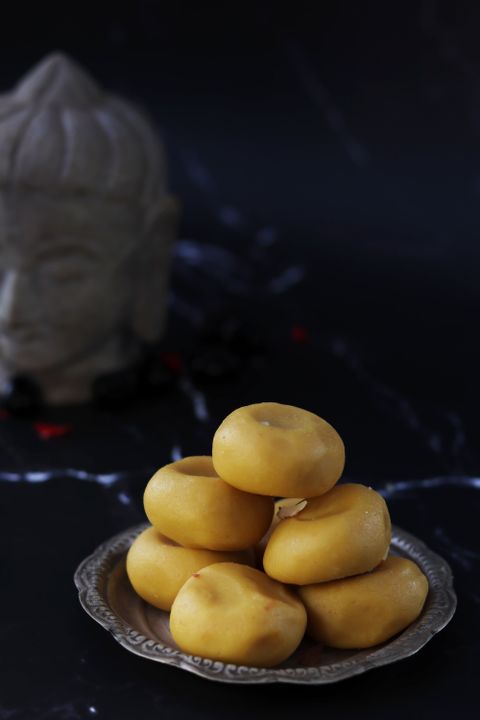
7. Mawa Peda
What it is: Khoya (mawa) combined with powdered sugar and cardamom, shaped into small rounds and garnished with pistachio.
Key technique: Source good-quality khoya, or make it at home by reducing full-fat milk to one-quarter of its original volume over 45-60 minutes of continuous low-medium heat stirring. Shape the peda while the mixture is warm — it hardens as it cools and becomes difficult to shape.
Common mistake: Letting the mixture cool before shaping. It sets quickly and doesn’t respond well to reheating.
Make-ahead window: 3 days at room temperature, up to 1 week refrigerated.
8. Chikki (Groundnut)
What it is: Roasted peanuts set in jaggery syrup, poured thin and cut into rectangles before it hardens.
Key technique: The jaggery must reach hard-ball stage. Drop a small amount of syrup into cold water — it should form a firm ball that holds its shape. Pour immediately onto a greased surface and cut within 90 seconds. Chikki sets in under 2 minutes at room temperature.
Common mistake: Pouring at the wrong stage. Too early and the chikki stays chewy and sticky. Too late and it shatters when cut rather than breaking cleanly.
Make-ahead window: 3 weeks in an airtight container — the longest shelf life of all 8 sweets.
- ahead storage windows for all 8 mithai (days at room temp)
- data from recipe section above
Source: Florence Academy
What Equipment Do You Really Need to Make Mithai at Home?
The Indian home cooking equipment market has seen sharp growth in small-batch specialty tools, but mithai-making requires far less than most people assume (IBEF, 2024). You don’t need a commercial sugar boiler, a tilting kettle, or a planetary mixer. Here’s the complete list.
The only essential equipment:
- Heavy-bottomed pan — stainless steel or hard-anodised aluminium. Not non-stick. You need to apply high, sustained heat for some mithai without the coating degrading. A thick base prevents hot spots that cause uneven roasting.
- Digital thermometer (₹800-1,200) — for any recipe involving sugar syrup, this single tool removes the guesswork from stage identification. The cold water test works, but thermometer readings are faster and more consistent.
- Greased tray or plate — for setting barfi and fudge-style sweets. Have it ready before you start cooking, not after.
- Parchment paper — for rolling kaju katli dough without it sticking to the surface.
- Bench scraper or clean knife — for cutting set mithai cleanly.
That’s it. Total equipment cost, if you’re starting from nothing: under ₹1,500.
: Most mithai failures trace back to one of three causes: wrong sugar stage, under-roasting, or impatience during setting. Every recipe in this guide has exactly one of these three as its critical variable. You don’t need to master all three at once. Pick one recipe, identify its single key variable, and practise until that variable feels intuitive. Once besan laddoo’s roasting stage is instinctive, mohanthal’s one-string syrup becomes the next puzzle. This sequential approach works better than attempting kaju katli on your first session.
Ready to learn from expert chefs? Explore Courses at Florence Academy
Frequently Asked Questions About Homemade Mithai
What is the difference between khoya and mawa?
Khoya and mawa are the same ingredient — the terms are completely interchangeable. Both refer to full-fat milk reduced by evaporation to a dense, nearly-solid form. The process takes 45-60 minutes of continuous stirring on low-medium heat. “Khoya” is more common in North India; “mawa” is the standard term in Gujarat and Western India. It’s the base for mawa peda, gulab jamun, many barfis, and karanji. (ICMR-NIN) Gujarati culinary traditions and ingredients →
Can you make mithai without refined sugar?
Yes — jaggery (gur) substitutes for refined sugar in most mithai. Jaggery has a glycaemic index of approximately 84 compared to refined sugar’s 65-100, and adds a distinctive molasses character to the finished sweet (ICMR-NIN). It’s the traditional sweetener in chikki, many halwas, and some laddoo varieties. Date paste works in no-cook mithai like anjeer barfi. One note: jaggery-based mithai has a slightly shorter shelf life because of higher residual moisture.
How do you know when sugar syrup is at the right consistency?
The cold water test is reliable and requires no equipment. Drop a small amount of syrup into a bowl of cold water and observe it. One-string consistency, where a thread forms between your thumb and finger before breaking (110-112°C), is correct for mohanthal, halwa, and peda. Soft-ball stage, where the syrup forms a pliable ball in water (115-118°C), is correct for kaju katli. Hard-ball stage, where the ball is firm (124-130°C), is correct for chikki. A digital thermometer costing ₹800-1,200 eliminates guesswork entirely. Florence Academy workshops on Indian sweets techniques →
Which mithai is the most beginner-friendly?
Besan laddoo is the most forgiving starting point. The only critical variable is roasting time, and properly roasted besan has a distinctive nutty smell that you’ll recognise immediately once you’ve experienced it. Anjeer barfi is even simpler because there’s no cooking at all — just blending and pressing. Kaju katli sits at the other end of the difficulty scale because the sugar stage requires precision and practise. The recommended sequence: besan laddoo first, then anjeer barfi, then kopra pak or mawa peda, and finally kaju katli when you’re confident with sugar stages.
The Practical Case for Making Mithai at Home
The argument for homemade mithai isn’t sentimental. It’s practical. FSSAI surveillance data shows documented adulteration in commercial khoya (FSSAI, 2024). Commercial production optimises for cost and shelf life, not for flavour or ingredient quality. When you make mithai at home, you make every decision that matters: the ghee, the sugar, the roasting time, the freshness.
None of the 8 sweets in this guide require specialist equipment or professional training. They require patience, attention to one key technique per recipe, and a willingness to make the same sweet two or three times until the critical variable becomes instinctive. That’s how traditional mithai-making was always learned — in kitchens, not in factories.
The next time you need to bring something to a celebration, consider making it rather than buying it. The quality difference is real, and the process is more straightforward than most people expect.
Gujarati festival food traditions →
Have questions? Chat with us on WhatsApp — we respond fast.


