

Every year, thousands of students in Ahmedabad, Gujarat, and across India face the same fork in the road: should you invest 1–2 years in a culinary diploma, or commit 3–4 years to a Bachelor of Hotel Management (BHM) degree? The answer isn’t one-size-fits-all, but it is actually quite clear once you define your goal. In 2026, India’s hospitality sector is projected to grow at 14.76% CAGR to reach USD 55.67 billion by 2031 (Mordor Intelligence, India Hotel and Hospitality Market, 2025). Both paths lead to real careers. But they lead to different careers, on different timelines, at different costs.
If your goal is to cook professionally, this comparison will save you two years and a significant amount of money.
You can browse Florence Academy’s full range of culinary programmes to compare your options as you read through this guide.
By Chef Monila Surana, Florence Academy of World Cuisines
Key Takeaways
– Culinary diploma students enter the workforce 2–3 years faster than BHM graduates, reaching paid kitchen roles sooner
– In 2026, a Sous Chef earns ₹35,000–₹60,000/month — a salary diploma graduates reach at the same pace as degree holders for kitchen roles
– NSDC and AHLEI-certified culinary diplomas carry equal industry recognition for kitchen roles at ITC Hotels, Marriott, and similar brands
– Hotel management degrees open broader options (front office, F&B management, housekeeping) but are classroom-heavy and slower to the kitchen
– For students whose clear goal is to cook professionally, a culinary diploma wins on ROI (Mordor Intelligence, 2025)
The Core Question: What Do You Actually Want to Do?
Before comparing programmes, define your target. That single decision determines which path makes sense. The two qualifications are designed for genuinely different outcomes, and treating them as interchangeable is the most common mistake students make at this decision stage.
A culinary diploma is designed to produce kitchen professionals: chefs, pastry specialists, culinary leads, and food entrepreneurs. It is vocational, skills-first, and built around daily practical training. An hotel management degree (BHM) is designed to produce hospitality managers: professionals who can work across front office, food and beverage operations, housekeeping, events, and general management. The kitchen is one module among many.
If you want to run a restaurant, a cloud kitchen, or a professional kitchen, the diploma is the faster and more cost-effective route. If you want to manage a hotel’s food and beverage department or move into hospitality operations broadly, the degree opens more doors.
The rest of this comparison will help you validate that decision with data.
How Do Duration and Time-to-Employment Compare?
Culinary diploma graduates enter the paid workforce 2–3 years earlier than BHM graduates, a gap that compounds significantly in early career earnings. In 2026, the Tourism and Hospitality Skill Council’s Skill Gap Study found that India’s hospitality sector will need 3 million additional skilled workers by 2028, with only 1% of interested candidates formally trained (THSC / MSDE, Sub-Sector-Wise Demand and Skill Gap Study, 2024). The market isn’t waiting for four-year graduates.
A culinary diploma runs 6 months to 2 years depending on the programme level. A BHM degree runs 3–4 years. Both are full-time commitments. But the diploma graduate is in a professional kitchen earning a salary while the BHM student is still completing electives in hospitality law and rooms division management.
That early career period matters. Two to three additional years of paid kitchen experience, combined with earlier progression up the brigade, means diploma graduates typically reach Sous Chef salary levels (₹35,000–₹60,000/month) before many BHM graduates complete their degree.
Culinary Diploma vs Hotel Management Degree: At-a-Glance Comparison
India, 2026 · Sources: THSC 2024; Shiksha 2025
| Category | Culinary Diploma | Hotel Management Degree (BHM) |
|---|---|---|
| Duration | 6 months – 2 years | 3–4 years |
| Time to First Paid Role | 6–24 months | 3–4 years |
| Practical Training | ~80% hands-on | ~40–50% hands-on |
| Cost Range (General) | More affordable | Higher (4-year fees + living costs) |
| Kitchen Career Entry | Direct — Commis Grade 1 | Commis or management trainee |
| Scope of Career Roles | Kitchen-focused | Broader (F&B, front office, ops) |
| NSDC/Skill India Recognised | Yes (accredited institutes) | University/AICTE recognised |
| Best For | Students whose goal is to cook professionally | Students targeting hospitality management |
Comparing your options? Explore Culinary Diploma Programs at Florence Academy →
Which Programme Gets You Into a Professional Kitchen Faster?
In 2025, Shiksha’s chef salary survey confirmed that NSDC-recognised diploma holders enter professional kitchens at Commis Grade 1 with ₹15,000–₹25,000/month — the highest entry grade — bypassing the two lower Commis grades that non-certified kitchen entrants must work through (Shiksha, Chef Salary in India, 2025, retrieved June 2026).
At Florence Academy, we track our graduates’ placement timelines closely. Those completing the 2-year Diploma in Food and Beverages typically receive placement offers within 4–8 weeks of graduation, entering at Commis Grade 1 at partner properties including ITC Hotels and Marriott. Students completing the 6-month Culinary Foundation Programme often secure entry positions even before graduation completes. That timeline simply isn’t possible with a 3-year BHM degree.
BHM graduates do enter the hospitality workforce with a broader base, often as management trainees rather than kitchen staff. But if your goal is a cooking role, a management trainee programme typically means spending additional months rotating through front office, housekeeping, and F&B service before getting meaningful kitchen time. For kitchen-focused candidates, this is a delay, not an advantage.
Verdict: Culinary diploma wins for speed to kitchen employment by 2–3 years.
Is the Culinary Diploma as Recognised as a Degree by Hotel Employers?
Yes, for kitchen roles. NSDC and AHLEI-certified culinary diplomas carry equal industry recognition among India’s top hotel employers for kitchen positions. This is not the general case often assumed. India has 490+ culinary arts colleges, with THSC alone operating 243 affiliated training centres nationwide (Shiksha.com, Best Culinary Arts Colleges in India, 2024–2025). The key is not the format of the qualification; it’s the accreditation attached to it.
Hotel HR departments at ITC, Marriott, Hyatt, and similar brands screen for NSDC or THSC affiliation when evaluating culinary candidates. A diploma from an NSDC-recognised institute satisfies that filter just as effectively as a BHM degree for Commis and Chef de Partie roles. The BHM degree has an advantage for management-track positions, but the kitchen career track does not require it.
Where the BHM degree holds a genuine advantage is for roles beyond the kitchen: Food and Beverage Manager, Operations Manager, General Manager, or any corporate role in hotel management. These positions draw on the degree’s broader curriculum in hospitality operations, finance, and people management. If that’s your long-term goal, the BHM’s extra years are an investment in a wider career range.
The assumption that a degree automatically outranks a diploma in hotel kitchens persists among students, but it doesn’t hold up with employer data. What hotel kitchens measure at the Commis level is practical skill: knife work, mise en place discipline, brigade culture, and food safety compliance. An 80% hands-on culinary diploma produces demonstrably better practical readiness than a degree programme where kitchen training is one component among many theoretical subjects. Hotels know this. The accreditation on the diploma, not the degree/diploma label itself, is what their HR processes check.
Citation Capsule (1 of 2): In 2026, the Tourism and Hospitality Skill Council (THSC) operated 243 affiliated training centres across India, and Shiksha’s 2025 chef salary survey confirms that NSDC-accredited culinary diploma holders enter professional kitchens at Commis Grade 1 (₹15,000–₹25,000/month), bypassing the two lowest entry grades — a concrete advantage over non-certified kitchen entrants (Shiksha, Chef Salary in India, 2025). For kitchen-focused hiring at India’s top hotel brands, NSDC or THSC affiliation on a culinary diploma carries equal weight to a BHM degree. The qualification format matters less than the accreditation behind it (THSC, 2024–2025.
How Do Salary Outcomes Compare Between the Two Paths?
For kitchen roles, salary outcomes are broadly comparable within 4–5 years of graduation, but culinary diploma graduates get there 2–3 years sooner. In 2026, a Commis Chef entering with a recognised diploma earns ₹15,000–₹25,000/month from day one. A Sous Chef earns ₹35,000–₹60,000/month. An Executive Chef at a top property earns ₹1,00,000–₹2,00,000/month (Shiksha, Chef Salary in India, 2025).

A BHM graduate entering as a management trainee may start at a similar base, but their kitchen time is limited in those early months. The diploma graduate, meanwhile, is accumulating kitchen hours and brigade experience that directly accelerate progression. By year 4 or 5, the diploma graduate is typically at Chef de Partie level (₹25,000–₹42,000/month) while a BHM graduate who graduated at the same time is only just completing their degree.
The exception is the management track. BHM graduates who move into Food and Beverage Manager or operations roles can reach higher organisational salaries faster than a kitchen-only career arc allows. But that’s a different career. For the kitchen career, the diploma’s earlier start compounds into a meaningful lifetime earnings advantage.
Speed to Salary: Culinary Diploma vs BHM Graduate
India, 2026 — Kitchen career track · Source: Shiksha 2025
| Year 1–2 Diploma: Commis G1 BHM: Still in college |
|
Diploma: ₹15K–₹25K/mo | ||
| Year 3–4 Diploma: Chef de Partie BHM: Graduating / Year 1 |
|
Diploma: ₹25K–₹42K/mo | ||
| Year 5–7 Diploma: Sous Chef BHM: Chef de Partie |
|
Diploma: ₹35K–₹60K/mo | ||
| Year 10+ Both: Head/Exec Chef |
|
Both: ₹1L–₹2L+/mo |
Is Practical Training Really Different Between the Two?
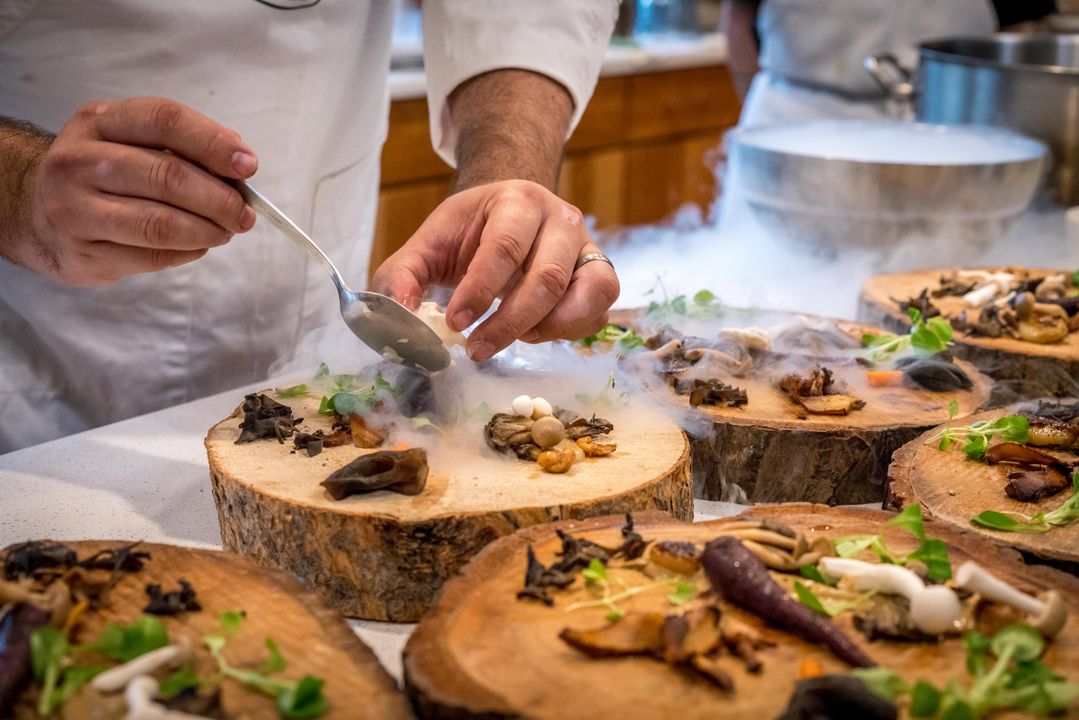
Yes, and this difference has a direct effect on how quickly you’re productive in a professional kitchen. A culinary diploma from a quality institute is approximately 80% hands-on training: daily sessions in a commercial kitchen, service simulations, mise en place drills, and technique repetition under professional instruction. A BHM degree is substantially more classroom-heavy, covering hospitality management theory, accounting, marketing, HR, and operations alongside kitchen modules.
At Florence Academy, our 2-year Diploma in Food and Beverages runs with a 2:1 student-to-faculty ratio across 350+ recipes. Students work in a commercial training kitchen from week one. By the time a diploma graduate walks into their first Commis interview, they have completed hundreds of service sessions. Hotel kitchen assessors notice this difference immediately in practical tests.
India’s foodservice market was valued at USD 85.19 billion in 2025 and is growing at 10.3% CAGR toward USD 153.37 billion by 2031 (Fortune Business Insights, India Foodservice Market, 2025). In a market growing this fast, employers need people who can be productive immediately. Practical training volume is what creates that readiness.
BHM students are not learning less. They are learning more broadly. But “more broadly” means kitchen technique is a smaller proportion of their total education time. A BHM student who genuinely wants to specialise in kitchen leadership often chooses to supplement their degree with short culinary courses anyway, which tells you something about the practical gap.
The honest comparison: if you want to be brilliant at cooking and running a kitchen, the diploma is better preparation. If you want to understand an entire hotel’s operations at a general management level, the degree is worth the extra time.
What Career Doors Does Each Path Open?
The culinary diploma leads directly to kitchen roles: Commis Chef, Chef de Partie, Sous Chef, Head Chef, Executive Chef, pastry specialist, culinary entrepreneur, and food business owner. These are focused, clearly defined outcomes that the diploma is built around. In 2026, the Indian bakery market alone was valued at $13.8 billion and growing at 9.12% CAGR, and cloud kitchen operators with culinary training are among the highest-growth employment categories in India’s food sector (Expert Market Research, India Bakery Market, 2024).
The BHM degree opens a wider set of doors: hotel operations manager, food and beverage manager, housekeeping director, front office manager, revenue manager, and eventually general manager of a hotel property. It’s a management degree with hospitality specialisation. The kitchen is one of many departments it prepares you to oversee, not necessarily to cook in.
For students who are genuinely uncertain about whether they want to cook or manage, the BHM’s breadth can be valuable. It keeps options open. But that breadth comes at a cost: 3–4 years of study, higher total fees, and a slower path to the kitchen if that’s eventually where you land.
The question to ask yourself honestly is: in five years, do I want to be running a kitchen section, or running a hotel department? Both are great careers. But they require different preparation, and choosing the wrong path costs real time.
Which Programme Is Right for You?
The decision is clear if your goal is clear. Here are the four most common student profiles and the direct recommendation for each.
The student who wants to cook professionally: Choose the culinary diploma. You’ll enter the workforce 2–3 years earlier, start at Commis Grade 1 with an NSDC-recognised credential, and reach Sous Chef salary range (₹35,000–₹60,000/month) faster. Florence Academy’s Diploma in Food and Beverages carries NSDC, AHLEI, and THSC accreditation and places graduates at ITC Hotels and Marriott.
The student who wants to manage a hotel: Choose the BHM degree. The broader curriculum in operations, finance, and people management is genuinely necessary for general management roles. The kitchen specialisation alone isn’t enough.
The student who wants to specialise in baking and pastry: Choose a dedicated bakery diploma. Florence Academy’s Diploma in Artisanal Bakery and Patisserie is the targeted qualification for this track, covering professional-grade techniques including the eggless and Jain-adapted baking methods that are in particularly high demand in Gujarat.
The student who is still exploring: Start with a shorter programme before committing. Florence Academy’s Culinary Foundation Programme (6 months) or Bakery Foundation Programme are structured starting points that build real skill and help you make the longer-term decision from a position of experience rather than assumption.
Citation Capsule (2 of 2): In 2026, India’s hospitality sector requires 3 million additional skilled workers by 2028, yet only 1% of interested candidates are formally trained, according to the THSC Sub-Sector-Wise Demand and Skill Gap Study 2024. For kitchen roles, NSDC-accredited culinary diploma holders enter at Commis Grade 1 (₹15,000–₹25,000/month) and reach Sous Chef level (₹35,000–₹60,000/month) 2–3 years faster than BHM graduates following the same kitchen career path. For students whose goal is to cook professionally, the culinary diploma delivers a materially better return on time and investment (THSC / MSDE, 2024; Shiksha, 2025).
Making the Final Decision
Here’s the clearest summary we can offer. The culinary diploma wins on ROI for kitchen careers: shorter duration, lower total cost, faster employment, and equal industry recognition at hotel employers for the kitchen track. The BHM degree wins for career breadth: more roles, more departments, and the management credential that hotel groups look for when promoting into general operations.
India’s hospitality market is growing. The Travel and Tourism sector supported 46.5 million jobs across India in 2024, accounting for 9.1% of total national employment (WTTC, 2025). There are real careers in both paths. But choosing the wrong one costs 2–3 years you won’t get back.
If the goal is to cook, the diploma is the right answer.
You can view all of Florence Academy’s diploma and foundation programmes to find the programme that matches your timeline and goals. You can also learn about our faculty, accreditation, and placement partners before making a decision.
Join 2,000+ students who’ve trained with expert chefs at Florence Academy, Ahmedabad.
Have questions about which program suits you? Chat with us on WhatsApp — we respond fast.
Phone: +91 6351665305 | +91 8320715588
Frequently Asked Questions
Is a culinary diploma better than a hotel management degree?
It depends on your goal. For kitchen roles, a culinary diploma is faster and more cost-effective: graduates enter the workforce 2–3 years earlier and reach Sous Chef salary (₹35,000–₹60,000/month) sooner. For hospitality management roles across front office, F&B operations, and hotel leadership, the BHM degree opens broader options. The culinary diploma wins on ROI if your goal is to cook professionally. (THSC, 2024; Shiksha, 2025)
Explore diploma programmes at Florence Academy
Do hotels accept culinary diplomas for kitchen roles?
Yes. NSDC and THSC-accredited culinary diplomas are accepted by India’s top hotel brands, including ITC Hotels, Marriott, Hyatt, and Oberoi, for kitchen positions. NSDC accreditation is the qualification filter hotel HR departments apply for culinary roles. A diploma from a recognised institute satisfies that requirement equally to a BHM degree for Commis, Chef de Partie, and Sous Chef positions. (THSC, 2024–2025)
Learn about Florence Academy’s NSDC, AHLEI, and THSC accreditation
What is the salary after a culinary diploma in India?
Culinary diploma graduates enter as Commis Chef Grade 1 at ₹15,000–₹25,000/month with an NSDC-recognised diploma. Progression to Chef de Partie (₹25,000–₹42,000/month) typically takes 2–4 years, Sous Chef (₹35,000–₹60,000/month) another 3–5 years, and Executive Chef (₹1,00,000–₹2,00,000/month) at 12+ years. Pastry specialists with formal diplomas earn a 20–35% premium over standard brigade ranks at equivalent experience. (Shiksha, Chef Salary in India, 2025)
How long is a culinary diploma in India?
Culinary diploma programmes in India run from 6 months to 2 years, depending on the level and specialisation. A foundation programme (6 months) builds core culinary or bakery skills. A full diploma programme (1–2 years) delivers the comprehensive training and NSDC/THSC accreditation that hotel employers require. Florence Academy’s Culinary Foundation Programme runs 6 months; the 2-year Diploma in Food and Beverages is the full career-track qualification.
What is the difference between NSDC certification and a BHM degree?
NSDC (National Skill Development Corporation) certification is a nationally recognised accreditation that validates vocational training from affiliated institutes. A BHM degree is a 3–4 year university degree recognised under AICTE. For kitchen roles, NSDC-certified diplomas and BHM degrees are treated as equivalent by hotel employers. NSDC certification is faster to obtain and more focused on practical skill. A BHM degree is broader and required for management-level hotel operations roles beyond the kitchen.


