
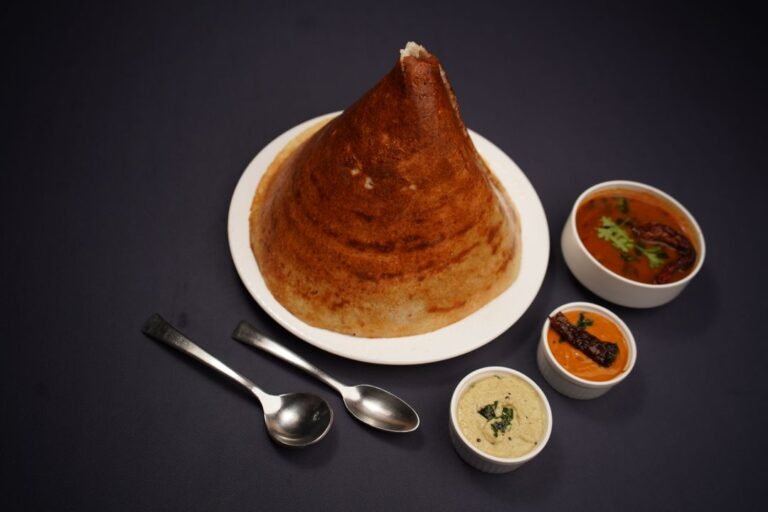
Khaman and dhokla are both steamed Gujarati farsan, often served side by side in Ahmedabad. Published recipes, though, make them in quite different ways. The khaman vs dhokla question comes down to three things: what the batter is made of, what makes it rise, and how long it waits before steaming.
This guide compares how established recipe sites make three versions: instant khaman, fermented khatta dhokla and instant rava dhokla. Where an ingredient matters for Jain households, we point it out. Why fermented batter rises is explained in our idli and dosa batter science guide, so we do not repeat it here.
Key Takeaways
– Swasthi’s Recipes describes khaman as “a type of dhokla made instantly without fermenting the batter.”
– Instant khaman is made from besan and raised with Eno fruit salt or baking soda plus an acid such as citric acid or lemon juice.
– Archana’s Kitchen’s khatta dhokla soaks equal parts rice, urad dal and chana dal for 6 hours, then ferments the batter 8 hours or overnight.
– Steaming times in the recipes we read range from about 8 to 20 minutes. Every recipe that gives a doneness test uses a clean toothpick or knife.
– Most of the recipes use ginger and hing. Hebbar’s Kitchen’s instant khaman, which it calls nylon khaman, lists no ginger but adds a pinch of hing.
Want to learn this hands-on?
Florence Academy's courses are 100% vegetarian, with Jain-adapted recipes available. Join 2,000+ students who have trained with expert chefs at Florence Academy, Ahmedabad.
What Is the Difference Between Khaman and Dhokla?
The batter. Hebbar’s Kitchen puts it plainly: “the traditional one is made with rice and chickpea flour, the latter [nylon khaman] is made with just chickpea or besan flour”, and “the traditional dhokla batter is prepared overnight and fermented, whereas nylon dhokla does not require any fermentation” (Hebbar’s Kitchen, 2023). Swasthi’s Recipes says khaman is made “instantly”, while traditional dhokla is made “by grinding soaked dal, later fermented and steamed” (Swasthi’s Recipes, updated 2026).
Not every cook draws the line the same way. A Gulf Times article gives a khaman made from chana dal and left “at a warm place to ferment overnight”, and says “only a trained eye can tell the difference between dhokla and khaman” (Gulf Times, 2018). So in the recipes we read, instant besan khaman is the usual version, but a fermented chana dal khaman also exists.
| Instant khaman | Khatta dhokla | Rava dhokla | |
|---|---|---|---|
| Base | Besan (gram flour) | Rice, urad dal and chana dal | Semolina (rava) and curd |
| What makes it rise | Eno or baking soda, plus citric acid or lemon | Fermentation | Eno |
| Waiting time | None; steam at once | 6 h soak plus 8 h ferment | About 20 min rest |
| Steaming time | 10 to 20 min | About 10 min | About 20 min |
The table summarises the recipes described below.

How Do Published Recipes Make Instant Khaman?
Besan, an acid and a fast-acting raising agent, steamed straight away. These are four recipes side by side.
| Recipe | Besan | Raising agent and acid | Ginger | Steaming |
|---|---|---|---|---|
| Swasthi’s Recipes | 2 cups (220 g), plus 2 tbsp fine semolina | 1½ tsp Eno or 1 tsp baking soda; 1 tsp citric acid or 2 tbsp lemon juice | Yes | 18 min for an 8-inch pan |
| Hebbar’s Kitchen (nylon khaman) | 2 cups | 1 tsp Eno and 2 tbsp lemon juice | None listed | 20 min |
| Archana’s Kitchen | 1½ cups | ¼ tsp cooking soda, 1 tsp Eno, 1 tbsp lemon juice | Yes | 10 min in a steamer |
| Ranveer Brar | 2 cups | 2 tsp fruit salt, 1 tsp lemon juice, ⅓ cup curd | Yes | 15 min in a pressure cooker, whistle removed |
Swasthi explains that the acid replaces the tang that fermentation would give, and says it “helps preserve the dhokla longer since it works as a preservative.” Hebbar’s Kitchen says that because there is “no fermentation in this recipe, eno and citric acid are typically used to get the softness”, and that lemon juice “could be the best alternative” to citric acid.
Timing matters once the raising agent goes in. Hebbar’s Kitchen says to “steam the batter immediately, or else the dhokla will not be soft and fluffy.” Swasthi warns that a “Thicker batter will result in a dense and crumbly dhokla.”
Ranveer Brar’s method uses a pressure cooker as a steamer: plates on a stand, the whistle removed, cooked “over medium flame for 15-minutes” (Ranveer Brar). Archana’s Kitchen steams for about 10 minutes (Archana’s Kitchen, 2020).
What Is Actually in Eno?
An antacid. The label on Indian Eno, as reproduced by Apollo Pharmacy, lists “Svarjiksara (Sodium Bicarbonate)” and “Nimbukamlam (Citric Acid)”, and describes the product as an “effervescent antacid” (Apollo Pharmacy). Hebbar’s Kitchen says Eno and citric acid are used “to get the softness” because there is no fermentation. Recipes use it only as a raising agent; this guide does not cover its use as a medicine. Swasthi recommends the plain, unflavoured kind. Some recipes, including hers, give baking soda as an alternative.
How Is Fermented Khatta Dhokla Made?
Slowly. Archana’s Kitchen’s Gujarati khatta dhokla uses “1 cup Rice”, “1 cup White Urad Dal (Whole)” and “1 cup Chana dal”, soaked “in 3 cups of water for 6 hours”, ground with curd, then left to “ferment for 8 hours or overnight” (Archana’s Kitchen, 2020). It needs no Eno or soda. It steams for “about 10 minutes on high heat.”
Sanjeev Kapoor’s white dhokla takes a shortcut: it dry-roasts rice and urad dal and grinds them to a coarse powder instead of soaking, then mixes the powder with sour yogurt and warm water to “ferment for 8-10 hours.” It also adds baking soda and lemon juice after fermenting, so it combines both methods (Sanjeev Kapoor, 2018).

Ready to learn from expert chefs? Explore Courses at Florence Academy →
What About Rava Dhokla?
It sits between the two: no fermentation, but the rava rests for about 20 minutes before steaming. Hebbar’s Kitchen mixes coarse and fine rava with curd, ginger paste, chillies, sugar and a pinch of hing, rests it for 20 minutes “or until the rava is soaked well”, adds Eno and steams “for 20 minutes or until the toothpick inserted comes clean” (Hebbar’s Kitchen, 2019). It also warns not to combine turmeric with a baking agent, or the dhokla may turn red.
How Do You Know When Dhokla Is Steamed?
Every recipe that gives a test uses the same one; Sanjeev Kapoor’s white dhokla gives a time only. Swasthi steams “until a tester comes out clean”. Archana’s khatta dhokla says a “greased knife inserted into the center” should come out clean. Ranveer Brar uses a toothpick or knife and steams 5 more minutes if it is not ready.
Hebbar’s Kitchen adds two warnings: “Do not overcook it or even in high heat as it may lose its texture and softness”, and it “has to be steamed well, or else the dhokla will remain raw in the center.” Our suggestion is to check at the shortest time your recipe gives, then in short steps after that.
What Goes Wrong, and What Goes in the Tempering?
The recipes we read name these problems and causes:
| Problem | Cause the recipe gives | Source |
|---|---|---|
| Dense or crumbly | Batter too thick | Swasthi’s Recipes |
| Not soft or fluffy | Batter not steamed immediately after adding Eno | Hebbar’s Kitchen |
| Raw in the centre | Not steamed well | Hebbar’s Kitchen |
| Lost texture and softness | Overcooked, or steamed on high heat | Hebbar’s Kitchen |
| Turned red | Turmeric combined with a baking agent | Hebbar’s Kitchen (rava dhokla) |
For the tempering, the four khaman recipes agree on the basics.
All use mustard seeds, green chilli and curry leaves, with sesame or hing in some. Then comes a sweet liquid. Hebbar’s Kitchen boils “½ cup water, 2 tbsp sugar, and ¼ tsp salt” and lets the khaman rest “20 minutes so that the dhokla absorbs all the water.” Ranveer Brar uses coconut water instead of sugar water.
Are Khaman and Dhokla Suitable for Jain Households?
They can be, but check the ginger and the hing. Pew Research Center reports that “a majority of Indian Jains (67%) say they abstain from eating root vegetables”, and that “Jain religious teachings recommend against eating root vegetables, since pulling out a plant’s roots destroys the plant” (Pew Research Center, 2021). Pew does not name ginger. Ginger grows underground, so our suggestion is to ask any Jain household before you use it.
Among the recipes we read, Swasthi’s khaman, Archana’s Kitchen’s khaman and khatta dhokla, Ranveer Brar’s khaman and Hebbar’s rava dhokla all use ginger. Hebbar’s Kitchen’s nylon khaman lists none, but its tempering adds “pinch hing”. Archana’s khaman tempering has no hing but its batter has ginger. Most of the other recipes also use hing, in the tempering or the batter. Whether hing suits a particular Jain household is for that household to say, so ask. As our Kathiyawadi cuisine guide notes, practice on asafoetida differs between households.
For other Gujarati snacks, see our Diwali farsan guide and our Ahmedabad street food guide.
What This Guide Could Not Confirm
We could not open Veg Recipes of India or Tarla Dalal, so neither is included. We found no published recipe labelled as Jain khaman from a source we could read, no source explaining why some recipes add oil to the batter, and no verified history of the dish’s origins. We did not cook these recipes for this guide.
Frequently Asked Questions
Is khaman the same as dhokla?
Not quite. Swasthi’s Recipes calls khaman a type of dhokla made instantly without fermenting the batter, and Hebbar’s Kitchen says traditional dhokla uses rice and chickpea and is fermented overnight, while khaman uses only besan. Some cooks also make a fermented khaman from chana dal, so the line is not fixed.
Is khaman batter fermented?
Usually not, in the published recipes we read. Instant khaman uses besan with Eno or baking soda and an acid such as citric acid or lemon juice, and is steamed straight away. A Gulf Times recipe ferments a chana dal khaman overnight, so a fermented version does exist. Khatta dhokla is fermented.
How long should I steam khaman?
The four khaman recipes we read steam for 10 to 20 minutes: Archana’s Kitchen about 10, Ranveer Brar 15 in a pressure cooker without the whistle, Swasthi’s Recipes 18 for an 8-inch pan, and Hebbar’s Kitchen 20. Those that give a test use a toothpick or knife that comes out clean.
Can I use baking soda instead of Eno?
Some recipes allow it. Swasthi’s Recipes gives 1 teaspoon of baking soda as an alternative to 1½ teaspoons of Eno, and Archana’s Kitchen uses both together. Indian Eno’s label lists sodium bicarbonate and citric acid and calls it an antacid, so recipes using soda alone add their own acid.
Is dhokla Jain-friendly?
It depends on the recipe and the household. Most recipes we read use ginger, which grows underground, and Pew found that 67% of Indian Jains say they avoid root vegetables. Hebbar’s Kitchen’s nylon khaman lists no ginger but uses a pinch of hing. Ask the household about both before you cook.
Khaman or Dhokla: Which Should You Make?
It depends on your time. By the recipes we read, instant khaman needs no waiting before steaming, rava dhokla needs a 20-minute rest, and khatta dhokla needs about 14 hours of soaking and fermenting.
- In a hurry: for the khaman vs dhokla choice, besan khaman with Eno or soda and an acid, steamed at once.
- Planning ahead: soak rice, urad and chana dal, then ferment overnight for khatta dhokla.
- Test the same way: a clean toothpick or knife, every time.
- For Jain guests: check every recipe for ginger and hing.
About the author: Chef Monila Surana is Managing Partner and lead culinary educator at Florence Academy of World Cuisines, Ahmedabad, with 18 years of experience in culinary education and curriculum design.
Want hands-on practice with Indian snacks? See our Chaat and Fast Food course or the Culinary Foundation Program. Join 2,000+ students who’ve trained with expert chefs at Florence Academy, Ahmedabad.
Ready to learn from expert chefs? Explore Courses at Florence Academy →
Call us at +91 6351665305 | +91 8320715588
Have questions? Chat with us on WhatsApp — we respond fast.


