

Over 350,000 people are treated for kitchen knife injuries every year — and in Ahmedabad home kitchens and across India, the cause is almost never bad luck. It’s technique (CPSC, 2025). A professional chef holds a knife differently than most home cooks do right now. That difference — grip, angle, finger position — is the line between confident prep and a cut that ends your cooking session early.
At Florence Academy of World Cuisines in Ahmedabad, knife skills are the very first thing we teach every student — before a single flame is lit. This guide gives you the same 10 foundational skills our chefs cover in the classroom, adapted specifically for Indian home kitchens and vegetarian cooking.
Key Takeaways
– Over 350,000 kitchen knife injuries are treated annually, with 66% striking fingers and thumbs — most are preventable with correct technique (CPSC, 2025).
– Three core skills — grip, claw, and slice — cover the majority of everyday Indian cooking prep.
– India’s domestic cookware market is valued at USD 6.55 billion in 2025 and growing at 7.56% CAGR, reflecting a national surge in home cooking interest (IMARC Group, 2025).
– All 10 skills here are taught in Florence Academy’s foundational culinary courses, with hands-on practice from day one.
Why Knife Skills Are the Foundation of Every Dish
In 2025, India’s domestic cookware market reached USD 6.55 billion and is projected to hit USD 13.57 billion by 2035 at a 7.56% CAGR, driven primarily by rising interest in home cooking (IMARC Group, India Cookware Market, 2025). More people in Gujarat and across India are cooking at home than ever — yet most never receive formal instruction on the single most-used tool in their kitchen: the knife.
Knife technique isn’t just about speed. It’s about consistency and control. When you dice an onion unevenly, the small pieces burn before the large ones cook through. When you julienne paneer with varying thickness, it fries inconsistently. The cut directly affects the final texture, taste, and appearance of your dish — and proper technique protects your fingers while doing it.
Explore the Cooking and Culinary Arts courses at Florence Academy to find the right program for your skill level and goals.
Skill 1 — The Pinch Grip: Hold the Blade, Not Just the Handle
Most home cooks grip the handle. That’s the starting point — but not the correct position for controlled cutting. The professional method is the pinch grip: pinch the blade between your thumb and the side of your index finger right at the bolster (where blade meets handle). Your remaining three fingers wrap loosely around the handle.
This single adjustment transforms your control. The pinch grip puts your hand closer to the blade’s balance point, which means less effort per cut and far better directional accuracy. Culinary professionals consistently identify incorrect grip as the leading cause of both kitchen injuries and poor cutting consistency.
Indian kitchen application: You’ll often hold a knife for 20–30 minutes during heavy prep — dicing tomatoes, capsicum, and onion for a sabzi, or slicing okra for bhindi fry. The pinch grip dramatically reduces hand fatigue compared to a full handle grip. It also gives you precise control when you’re mincing green chillies or trimming the ends of French beans.
The common mistake to avoid: Placing the index finger along the top spine of the blade. This feels natural but eliminates lateral control — it’s the fastest path to an unintended slip.
Skill 2 — The Claw Technique: Your Fingers’ Best Defence
The claw is how professional chefs protect their fingers on every single cut. Curl your fingertips inward so your knuckles lead — the blade rests against your knuckles as you cut, physically preventing it from reaching your fingertips.
In professional kitchens — where 18% of chefs still report lacerations despite formal training — the claw is mandatory (CPSC NEISS, Journal of Emergency Medicine, 2012). At home, without formal training, the number is likely considerably higher. In 2025, 66% of all knife injuries struck fingers and thumbs (CPSC NEISS data). The claw is the single most effective preventive technique.
Why it matters for Indian cooking: The claw is especially critical when slicing firm vegetables: raw banana (kaccha kela), karela (bitter gourd), and bottle gourd (dudhi) — all staples in Gujarati home kitchens. These vegetables resist the blade more than soft tomatoes, so the knife is more likely to skip and slip.
Skill 3 — The Rock Chop: The Most-Used Cut in Any Kitchen
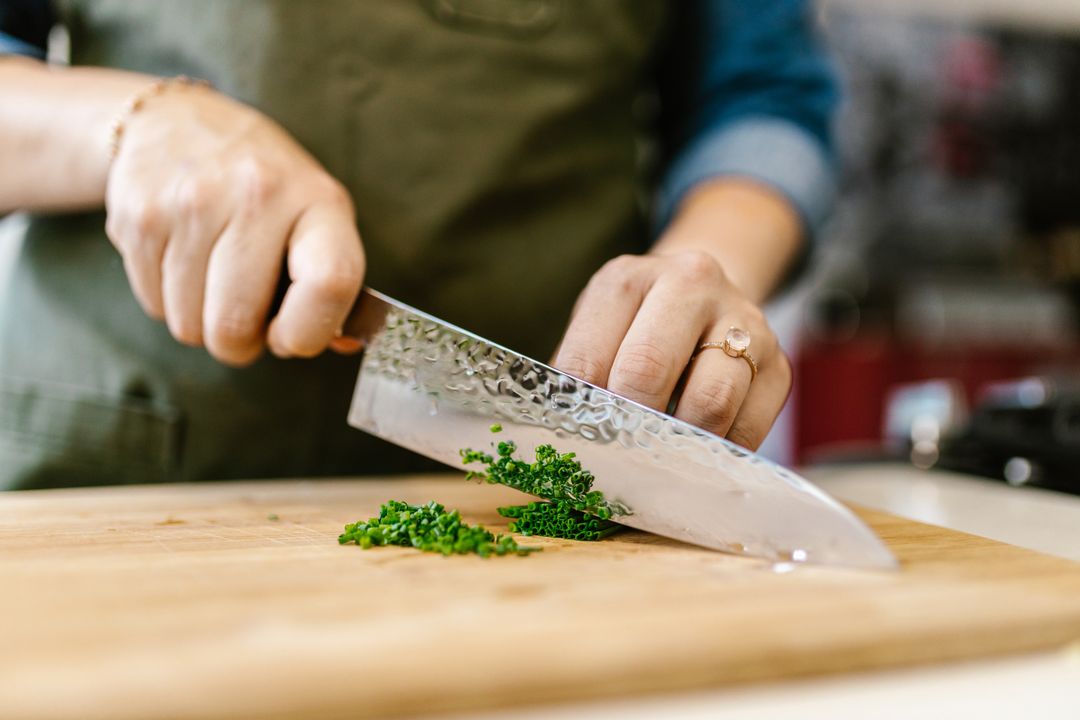
The rock chop — sometimes called the basic slice — is the foundation of kitchen prep. Keep the tip of the knife on the cutting board and rock the blade down and forward in a smooth arc. The tip stays down as a pivot point; you’re not lifting the full blade off the board with every stroke.
In Florence Academy’s foundational culinary curriculum, three moves — the rock chop, the quick dice, and the efficient slice — cover the prep requirements of the vast majority of Indian home recipes. The rock chop alone handles onions, tomatoes, capsicum, cabbage, ridge gourd, and most soft vegetables. Master this one cut first, and your kitchen speed improves immediately.
Jain kitchen note: Jain cooking avoids onions, garlic, and root vegetables, but the rock chop is equally essential for slicing turai (ridge gourd), parwal (pointed gourd), and French beans — all Jain staples. The technique doesn’t change; only the ingredient does.
Skill 4 — The Dice: Rough, Medium, and Fine
The dice is the rock chop applied in two directions to produce cubes. First, make horizontal cuts across the vegetable (where the shape allows), then vertical cuts along its length, then cross-cuts to produce even cubes. Size controls cooking time:
- Rough dice (2 cm): For slow-cooked dishes — dals, stews, curries where the vegetables soften over time
- Medium dice (1.2 cm): For subzis, stuffed parathas, and mixed rice dishes
- Fine dice (6 mm): For chutneys, raita toppings, and garnishes
Chef Monila Surana, who leads Florence Academy’s foundational cooking curriculum, makes one point consistently to every batch: uneven dice is one of the most common reasons home cooks end up with vegetables that are mushy in some places and undercooked in others. Consistent cube size controls the result.
From our kitchen: In Florence Academy’s foundational cooking batches, students who practise the medium dice on a full kilogram of onions before attempting a cooked dish consistently produce better results than those who skip straight to the stove. The repetition builds muscle memory before heat enters the equation.
Skill 5 — The Mince: For Ginger, Garlic, and Green Chilli
Mincing produces the finest possible pieces — far smaller than a fine dice. The technique: roughly chop your ingredient first, gather it into a tight pile, place your non-knife hand flat on the spine of the blade (not the edge), and rock the knife rapidly across the pile in a fan motion, rotating the pile and repeating until consistently fine.
Why this matters in Indian cooking: Virtually every Indian dish starts with minced ginger, garlic, or green chilli. Badly minced ginger leaves large fibrous pieces that don’t break down during cooking. Poorly minced green chilli releases heat unevenly — you’ll bite into a concentrated hot pocket instead of a balanced dish. The mince is one of the highest-impact skills for Indian cooking specifically.
Jain cooking note: Jain cooking replaces garlic with hing (asafoetida) and often uses dried ginger powder in tempering. But fresh green chilli mincing is still essential — and the same technique applies directly. Finely minced green chilli also replaces some of the heat lost when omitting garlic in Jain preparations.
Florence Academy’s Culinary Foundation Program covers Jain cooking adaptations as part of its practical curriculum — including knife technique applied to Jain-approved vegetables.
Ready to learn from expert chefs? Explore Courses at Florence Academy →
Skill 6 — The Julienne: Thin Strips for Stir-Fry and Salads
The julienne — called patla kaat in Gujarati kitchen practice — produces thin matchstick strips, typically 3 mm × 3 mm × 5 cm. The method: square off the vegetable to create a flat base, slice into 2–3 mm planks, stack the planks, then slice again into even strips.
Indian applications: Julienned paneer is the base for dishes like paneer jalfrezi and paneer bhurji. Julienned carrots feature in kachumber salad, poha, and upma. Julienned capsicum and tofu are the foundation of Indo-Chinese dishes — Manchurian, hakka noodles, crispy chilli — that appear on café menus and home tables across Ahmedabad.
What Chef Monila Surana sees most often: Home cooks attempt the julienne on round vegetables without squaring them first. The result is unstable, uneven strips that roll on the board and vary wildly in width. Always create a flat base before beginning any julienne.
Skill 7 — The Chiffonade: For Fresh Coriander and Curry Leaves
Chiffonade — French for “made of rags” — produces thin ribbon cuts from soft, leafy ingredients. Stack your leaves into a neat pile, roll them tightly into a cylinder, then slice perpendicular to the roll to produce thin, even ribbons. The tighter the roll, the more uniform the ribbons.
Indian kitchen priority: Fresh coriander (dhania) finishes nearly every Indian dish. Most home cooks hack at it without technique. A proper chiffonade or fine mince of coriander releases its full fragrance and distributes it evenly through the dish. Clumped, hacked coriander delivers uneven flavour and a rough appearance. The difference is immediately visible in the plating.
Curry leaves are typically fried whole in tadka, but a chiffonade works beautifully when you want fresh curry leaf flavour in raita, cold salads, or chaas without the whole leaf texture. Methi (fenugreek) leaves benefit from the same technique when used fresh as a garnish.
Skill 8 — The Brunoise: Precision Dice for Garnishes
The brunoise is a fine dice of 3 mm × 3 mm × 3 mm — the smallest standard cut in French technique, and the one that signals the most practised knife hand. It’s used primarily for garnishes: fine-diced tomato for raita, micro-diced capsicum for chaat topping (a Jain-friendly onion substitute), and finely diced cucumber for cold soups and salads.
It’s tedious. Most home cooks skip it entirely. But in a finished dish, a brunoise garnish signals care and precision in a way that rough chop can’t. Florence Academy students typically learn the brunoise in their second week of foundational classes — once grip, claw, and basic dice are already instinct.
Practical shortcut: Use the fine dice (6 mm) for most home cooking. Reserve the brunoise for dishes you’re serving at formal occasions or gifting — the visual difference is immediately noticeable.
Skill 9 — The Batonnet: Even Sticks for Snacking and Stir-Fry
The batonnet is a medium stick cut: 6 mm × 6 mm × 5–7 cm. Think of it as the precise, uniform version of the sticks you’re already cutting. It’s the foundation of both Indian stir-fry vegetables and the vegetable sticks served at Gujarati catering events. The batonnet is also the starting point for the dice — master this, and the next skill becomes easier.
Practical uses in Gujarat: Batonnets of raw mango (kacchi keri) are the prep base for aam ka achar. Batonnet-cut cucumber and carrot are standard for the raw vegetable platters at weddings and functions. Batonnet capsicum, paneer, and mushroom are the prep for tandoori skewers and grill platters — popular in both home kitchens and café formats across Ahmedabad.
The key is consistent width: 6 mm on all four sides. Uneven batonnets cook at different rates — you’ll pull some out undercooked while waiting for the thicker ones to finish.
Skill 10 — Knife Maintenance: Sharpening and Honing
A dull knife is more dangerous than a sharp one. This is kitchen fact, not caution — a sharp blade cuts cleanly with guided pressure; a dull blade requires force and skips unpredictably.
Two tools every home cook needs:
- Honing steel: Realigns the edge without removing metal. Use it before every cooking session — three or four swipes per side at roughly a 20-degree angle. This maintains sharpness between sharpenings.
- Whetstone: Actually sharpens by removing a thin layer of metal. Home cooks need this roughly once a month. Daily-use knives in professional kitchens get it weekly.
Storage: Never store knives loose in a drawer — contact with other utensils dulls the edge quickly and creates an injury risk when reaching in. A knife block, magnetic strip, or individual blade guards are all better options.
The tomato test: Press the blade against a ripe tomato skin with zero downward pressure — just guide it. A sharp knife passes through the skin cleanly. If you’re pressing before it cuts, your knife needs honing. This one test tells you everything about your knife’s condition before you start cooking.
Ready to Practise These Skills With Expert Guidance?

Reading about knife skills is the right first step. But truly ingraining them — so grip and claw become automatic, so your dice is consistently even without thinking — takes hands-on practice with real feedback. That’s exactly what Florence Academy’s cooking courses are built around.
In our foundational culinary programs, knife skills are the first two sessions. You don’t touch the stove until you’ve nailed the pinch grip, the claw, the rock chop, and the basic dice. By session three, students are julienning paneer and mincing green chilli with the speed and consistency of a professional kitchen.
Join 2,000+ students who’ve trained with expert chefs at Florence Academy, Ahmedabad.
Ready to cook with real confidence? Explore Courses at Florence Academy →
Have questions? Chat with us on WhatsApp — we respond fast.
Learn these skills hands-on in Florence Academy’s 6-Month Culinary Foundation Program — practical training from day one.
Frequently Asked Questions
What is the most important knife skill for a complete beginner?
The pinch grip is the single most important skill to learn before anything else. It gives you blade control and dramatically reduces injury risk. According to culinary professionals, incorrect grip is the leading cause of home kitchen knife injuries. Master the grip and claw in your first session — every other skill builds on those two.
Do I need an expensive knife to practise properly?
No. A mid-range 20 cm chef’s knife (₹800–₹2,000 from a reputable Indian brand) is sufficient for all 10 of these skills. What matters far more than price is sharpness. A ₹1,000 sharp knife outperforms a ₹10,000 dull one every time. Invest in a basic whetstone before upgrading your knife.
How long does it take to get good at knife skills?
Most students show significant improvement in basic slice, dice, and mince within two to three 90-minute practice sessions, based on teaching experience at Florence Academy. The julienne and brunoise take longer — typically 8–10 hours of focused practice. The foundational skills come quickly with the right instruction and consistent repetition.
Are these knife skills relevant if I follow Jain cooking?
Absolutely. Jain cooking avoids root vegetables but uses a wide variety of above-ground vegetables — and precise knife technique is just as critical. The julienne, brunoise, and chiffonade are all essential for Jain recipes. The mince applies directly to green chilli and ginger (both permitted in Jain cooking), and every safety technique is universal regardless of what you’re cutting.
Can I learn knife skills at Florence Academy without joining a full diploma course?
Yes. Florence Academy offers short workshops and short courses that cover practical cooking skills including knife technique. You don’t need to commit to a 1-year or 2-year diploma. Check the workshops page or contact us to find the format that fits your schedule and goals.
Is a heavier or lighter knife better for Indian cooking?
Most Indian culinary professionals use a medium-weight 20–22 cm chef’s knife for general prep. A heavier knife (200 g+) has more inertia per cut, which helps with firm vegetables like raw banana and dudhi. A lighter knife gives more precision for fine work like julienne and brunoise. Start with medium weight, then decide based on what you cook most often.
Start With Two Skills — Everything Else Follows
The difference between a confident home cook and a hesitant one usually comes down to one tool and ten techniques. Once the pinch grip and claw become instinct, every skill that follows — slice, dice, mince, julienne — builds naturally on top.
These aren’t advanced tricks reserved for professional chefs. They’re the basics that every professional learns first, and the basics that make daily cooking in an Ahmedabad kitchen faster, safer, and more satisfying.
Start with skills one and two. Practise them for a week. The rest follows.
Browse the full list of cooking and culinary arts courses at Florence Academy to find your next step.
About the Author
Chef Monila Surana is the Managing Partner and lead culinary educator at Florence Academy of World Cuisines, Ahmedabad. With 18 years of professional experience, she oversees curriculum design and daily operations at the academy. Florence Academy has trained 2,000+ students across vegetarian and Jain culinary specialisations, with placement partners including ITC Hotels and Marriott.
Sources:
– CPSC NEISS / Journal of Emergency Medicine, Knife-related injuries treated in US emergency departments 1990–2008, retrieved 2026-05-26, https://www.sciencedirect.com/science/article/abs/pii/S0736467912016241
– CPSC, Consumer Product Safety Commission — NEISS Injury Data, retrieved 2026-05-26, https://www.cpsc.gov/Research–Statistics/NEISS-Injury-Data
– IMARC Group, India Cookware Market Size, Share and Forecast 2025–2035, retrieved 2026-05-26, https://www.imarcgroup.com/india-cookware-market


