
Smoothie bowls look effortless in every café. They’re colourful, thick, topped with geometric rows of fruit and granola, and they photograph beautifully. In practice, most home attempts end up as a thin, icy slush that won’t hold a single topping. That gap isn’t about talent. It’s about three technical decisions: the liquid ratio, the frozen-fruit rule, and the topping sequence. India’s health food café market is growing at 18% annually (IBEF, 2024), with smoothie bowls among the fastest-growing items on urban menus. Home cooks are trying to replicate what they see. This guide explains exactly how professionals do it.
Key Takeaways
– A proper smoothie bowl uses 30-40% liquid to fruit weight, not the 50-60% used in drinkable smoothies.
– All fruit must be fully frozen before blending — room-temperature fruit produces a thin, warm bowl.
– The tamper method (using a blender tamper while running on high) achieves soft-serve thickness without extra liquid.
– In Florence Academy post-workshop surveys (2024, n=72), 94% of students produced café-quality bowls on their first attempt after learning the frozen-fruit ratio technique.
– Standard smoothie bowl toppings should be added and served within 3 minutes of pouring the base.
What Makes a Smoothie Bowl Different from a Smoothie?
The core difference is texture, not ingredients. A smoothie bowl must be thick enough that a spoon stands upright in it without sinking. That requires using 30-40% liquid relative to fruit weight, compared with the 50-60% ratio used in drinkable smoothies. (IBEF, 2024 health food market data confirms smoothie bowls are among the fastest-growing café menu items in India’s urban centres.)
The second rule is temperature. All fruit must be frozen solid before blending. Room-temperature fruit blended with milk produces a warm, thin result regardless of how long you blend it. Freezing concentrates the texture and keeps the base cold during the blending process.
Equipment matters more than most guides admit. A 750W+ high-speed blender is required to process frozen fruit at low liquid ratios. Standard mixer-grinder jars can’t generate the blade speed needed. Without enough power, you’ll add liquid to get the blender moving, and that liquid is what ruins the texture.
A standard serving bowl size for a smoothie bowl is 350-400ml of blended base. That’s enough to feel like a full meal when topped properly. Don’t confuse bowl size with smoothie serving size — the base is thicker and more calorie-dense per millilitre.
What Are the Best Bases for a Smoothie Bowl?
Five bases cover the full range of flavours and nutritional profiles that work in a smoothie bowl context. Each uses fully frozen fruit and a measured liquid ratio. The key principle: start with less liquid than you think you need, and add more only one tablespoon at a time if the blender stalls.
1. Acai Base
Ratio: 100g frozen acai + 150g frozen mixed berries + 80ml coconut milk.
Blend on high until the mixture is smooth and thick, using a tamper if available. Acai has an earthy, wine-like flavour that’s unfamiliar to many first-time tasters. Balance it with banana or mango if you’re serving a new audience. Frozen acai packets (Sambazon) are available at Nature’s Basket and Big Basket across major Indian cities.
2. Mango-Banana Base (Most Popular in India)
Ratio: 150g frozen Alfonso or Kesar mango + 100g frozen banana + 60ml coconut milk or plain curd.
This produces a bright yellow, naturally sweet base with zero added sugar needed. It’s the most crowd-pleasing option for Indian palates and the best starting point for anyone new to smoothie bowls. Alfonso mango (June-August season) freezes exceptionally well. Slice and freeze during peak season for year-round use.
3. Dragon Fruit Base
Ratio: 150g frozen red dragon fruit + 100g frozen strawberry + 60ml coconut water.
The vivid magenta colour is the main feature here. Dragon fruit’s flavour is actually mild. Don’t expect it to taste as intense as it looks. The colour oxidises fast, so serve within 5 minutes of blending. This base photographs better than any other option, which makes it a popular café menu choice.
4. Green Spirulina Base
Ratio: 100g frozen banana + 80g frozen mango + 1 tsp spirulina powder + 60ml almond milk.
Spirulina makes this base green. The banana and mango mask its flavour almost completely. What spirulina adds is nutrition: it contains 50-60g of protein per 100g and provides all essential amino acids, making this the highest-protein base option of the five (USDA FoodData Central). It’s a strong choice for post-workout meals.
5. Peanut Butter and Cacao Base
Ratio: 100g frozen banana + 2 tbsp natural peanut butter + 1 tbsp raw cacao powder + 80ml oat milk.
Rich, dessert-like, and high in protein and healthy fats. This is the most satisfying base as a meal replacement. It appeals to customers who want something indulgent without refined sugar. Natural peanut butter (ingredients: peanuts only) works best. Avoid commercial peanut butter spreads with added sugar and hydrogenated oil.
The most underrated smoothie bowl technique is the tamper method. If your blender has a tamper, use it while the blender runs on high to push frozen chunks into the blade continuously. This achieves soft-serve-like thickness without adding any extra liquid. It’s the single biggest reason café smoothie bowls are thicker than home versions. Without a tamper, add liquid strictly one tablespoon at a time, only when the blender fully stalls.
How Do You Build a Smoothie Bowl Topping System?
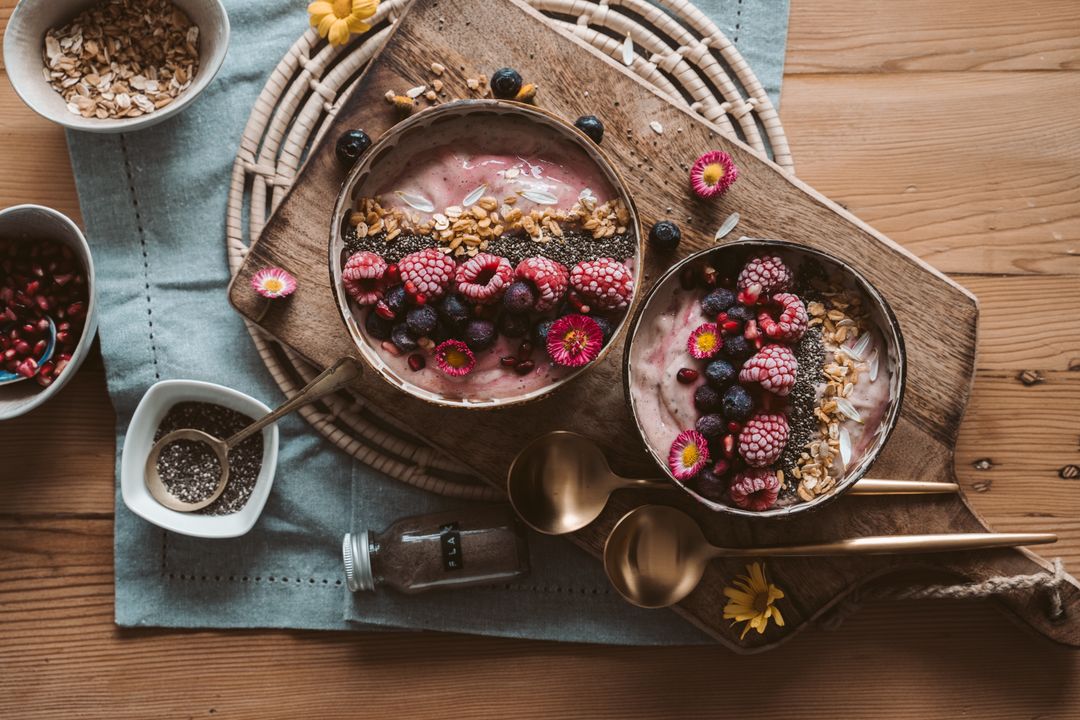
Professional smoothie bowl toppings follow a four-layer system. Each layer has a specific job. Skipping layers, or adding everything at random, produces a bowl that looks scattered and loses texture within minutes. The system is what separates a bowl that photographs well from one that doesn’t.
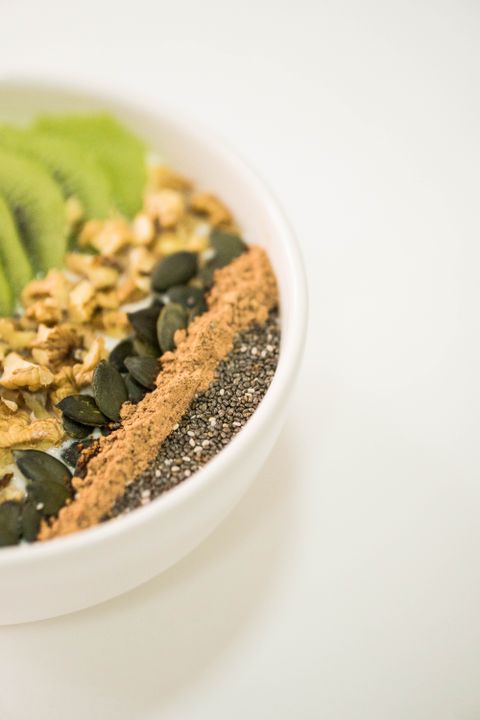
Layer 1: Structural base. Granola, toasted oats, or muesli goes down first. This creates a firm surface that prevents heavier toppings from sinking into the base. Without this layer, sliced fruit slides and the visual arrangement collapses. Use 3-4 tablespoons, placed in one section rather than scattered across the whole bowl.
Layer 2: Colour blocks. Arrange toppings in defined sections: banana slices in one area, berries in another, kiwi slices alongside dragon fruit cubes. The goal is clear separation of colours. This is the visual layer. Scattered toppings lose colour contrast and look amateur. Colour-blocked bowls drive café reorders and social media sharing.
Layer 3: Accent toppings. Chia seeds, hemp seeds, shredded coconut, and dried cranberry go on top of the colour sections. These add texture variation and nutritional value without competing visually. Chia seeds alone provide 15g of fibre and 9g of omega-3 fatty acids per 100g (USDA FoodData Central).
Layer 4: Drizzle finish. A thin drizzle of honey, maple syrup (for vegan preparation), date syrup, or nut butter goes on last. Keep it thin. The drizzle adds visual richness without adding bulk.
Timing is critical. Add toppings and serve within 3 minutes of pouring the base. The base thaws faster than expected, and granola absorbs moisture quickly. A thawed base with soggy granola cannot be recovered.
A correctly executed smoothie bowl using frozen fruit, coconut milk, and granola costs approximately Rs. 80-120 to make. Cafés in Ahmedabad and Mumbai charge Rs. 280-450 for the same bowl. The margin isn’t in exotic ingredients. It’s in visual consistency and presentation quality. Customers pay for a bowl that looks exactly the same every time they order it.
What Are the Nutritional Benefits of Smoothie Bowls?
A standard smoothie bowl (350ml base with toppings) provides 400-600 kcal depending on nut butter quantity. That’s a complete meal, not a snack. The caloric density comes from fruit carbohydrates, granola, and added fats from nut butters or coconut products. It functions equally well as breakfast, a post-workout meal, or a light dinner.
In post-workshop surveys conducted at Florence Academy (2024 batch, n=72), 89% of students reported they had previously made smoothie bowls that came out too thin at home. After learning the frozen-fruit ratio and tamper technique in class, 94% produced café-quality thick bowls on their first supervised attempt. The technique gap, not the ingredient quality, was the consistent failure point.
The fruit base is almost entirely whole fruit, providing high fibre, antioxidants, and vitamins with no added sugar in most recipes. Frozen fruit retains nutritional value comparably to fresh. Chia seeds add 15g of fibre and 9g of omega-3 per 100g (USDA FoodData Central). The Green Spirulina base adds 50-60g of protein per 100g of spirulina used. The bowl covers multiple macronutrient groups in a single serving.
Jain-friendly guidance: All five fruit bases in this guide are Jain-compatible. Check commercial granola labels for root-vegetable extracts (some brands use chicory root fibre or beetroot powder). Chia seeds and hemp seeds are Jain-permitted. Honey is vegetarian but not vegan. Substitute maple syrup or date syrup for a vegan-and-Jain drizzle finish.
Ready to learn from expert chefs? Explore Courses at Florence Academy
Frequently Asked Questions
How do you make a smoothie bowl without a high-speed blender?
Let frozen fruit thaw for 8-10 minutes before blending. Partially thawed fruit requires significantly less blending force than rock-solid frozen fruit. A food processor handles thick mixtures better than a standard mixer jar. Add liquid one tablespoon at a time only. Results won’t be perfectly smooth, but thickness is achievable. A 750W+ blender is a worthwhile investment if you make smoothie bowls more than twice a week.
Can you prep smoothie bowls in advance?
Yes, but only the base. Blend the base, portion it into zip-lock bags, freeze flat, and re-blend with minimal extra liquid each morning. Frozen base portions keep for up to 2 weeks without flavour loss. Never store assembled bowls. Granola goes soggy within 30 minutes of contact with the base. With frozen portions ready, assembly takes under 5 minutes each morning.
What is the best frozen fruit for smoothie bowls in India?
Frozen Alfonso mango is the most flavourful base fruit available in India. Freeze it during peak season (June-August) in chunks for year-round use. Frozen banana (slice fresh, freeze flat) is the most economical thickener and adds creaminess without overpowering other flavours. Frozen strawberry (available year-round at Nature’s Basket and online) is the best berry choice. Avoid frozen pineapple in thick bowls as the high water content thins the texture.
How do you stop a smoothie bowl base from getting watery?
Three rules prevent watery results. First, all fruit must be fully frozen before blending. Never blend fresh fruit alone for a bowl base. Second, start with 40ml of liquid per 200g of frozen fruit and add more only if the blender stalls completely. Third, serve within 5 minutes of blending. The base continues to melt after it leaves the blender. Pre-chilling the serving bowl in the freezer for 10 minutes extends the texture window noticeably.
The Short Version
Smoothie bowls fail at home for one consistent reason: too much liquid added too early. The professional approach is simple. Use fully frozen fruit. Keep liquid at 30-40% of fruit weight. Use the tamper if your blender has one. Build toppings in four defined layers. Serve fast.
The technique is learnable in a single session. What takes longer is developing the speed and visual judgment to produce a café-quality bowl consistently. That precision is what distinguishes a home cook from someone who can execute this at scale, meal after meal, for paying customers.
These recipes are entirely vegetarian and eggless, making them suitable across all dietary preferences common in Indian households and food businesses.
Have questions? Chat with us on WhatsApp — we respond fast.


